Tuesday, August 31, 2010

John Benson's tax-heavy voting record

In a previous blog post, I summarized the votes that make up Sen. Terri Bonoff's (DFL-Minnetonka) poor career rating on the Taxpayers League of Minnesota's legislative scorecards. In this post, I'll show why Rep. John Benson's (DFL-Minnetonka) career score is even lower than Bonoff's.

2007: Benson repeatedly voted in favor of what the Taxpayers League called a "bloated" transportation bill, then voted to override Gov. Pawlenty's veto of the bill, which would have raised taxes by billions of dollars, by up to $500 a year for a family of four. Benson also voted in favor of the Health and Human Services Finance bill, which would have reversed many welfare reforms and increased welfare spending in Minnesota (the bill was vetoed by Gov. Pawlenty). Rating: 25.

2008: Benson earned a big zero in this year, for voting contrary to Taxpayers League positions on every one of its tracked votes, including amending the state constitution to dedicate revenue from a new sales tax to fund "natural resource protection and cultural heritage programs;" levying an additional $6.6 billion in taxes on transportation and creating a new Twin Cities metro bureaucracy (vetoed by Gov. Pawlenty, veto overridden), and a $1 billion bonding bill with according to the Taxpayers League, "hundreds of millions for local arenas, hockey rinks, parks and trails and the Central Corridor lightrail boondoggle… with no money for state priorities like road and bridge construction." Rating: 0.

2009: Benson voted in favor of the $4.3 billion transportation bill that included funding for various light rail and commuter rail projects, continuing the trend for rail funding over highways; loan forgiveness for the city of St. Paul RiverCentre Arena totaling $32.75 million (vetoed by Gov. Pawlenty); and a $1 billion tax increase including the fourth tier tax increase, liquor tax increases, and cigarette tax (vetoed by Gov. Pawlenty; Benson voted to override the veto, which did not pass). Benson also voted in favor of the last-hour, end-of-session third attempt by the DFL leadership to pass a billion dollar tax increase. Rating: 7.

2010: At least Benson's score didn't go down this year, but in 2010 and 2009 he missed another zero score by only one vote. He voted against lowering the corporate tax rate (Minnesota has the third highest corporate income tax rate in the world!), in favor of adding a new fourth tier to the income tax, and voted to raise food, beverage, and lodging taxes for select cities as well as to authorize $34 million in additional debt for the Metropolitan Council. Rating: 7.

With another budget deficit looming, Minnesotans can ill-afford even more job-killing tax and spending increases. For more on John Benson's tax-and-spend voting record, and how you can help to restore fiscal sanity in the Minnesota Legislature, please visit the Brian Grogan for House web site (Twitter: @bwgrogan).

Saturday, August 28, 2010

Dillon to Chamber: government should live within its means

In its Minnesota Business Community 2010 Election Candidate Questionnaire, the Minnesota Chamber of Commerce scored SD43 Republican endorsed candidate Norann Dillon 23 points higher than Sen. Terri Bonoff (DFL-Minnetonka), 92% to 69%. The most telling difference came from this key question: "If elected, what will be your top priority?"

Bonoff: "Implementing a strategic plan that re-engineers the way we deliver all government services, leveraging the power and efficiency that modern technology provides. In addition, I will be a leader in making the strong and strategic reforms needed in our educational system so that each and every Minnesota child has an outstanding and excellent education. Our youngest learners must leave our schools college and post secondary ready to succeed."

Dillon: "My top priority will be to hold state government accountable to its number one responsibility: passing a genuinely balanced budget. The Legislature should decide how to spend your money by the Constitutionality, efficiency and effectiveness of programs and agencies. We need to apply the common sense that Minnesota families and businesses use every day: needs come before wants, you can't spend money you don't have, and plan for the long run. Let's look beyond the next election to create sustainable solutions and return our economy to prosperity."

While education reform is needed, Bonoff's focus on government services belies her overall philosophy that government just needs to be "more efficient" in its current role.

In contrast, Dillon would focus on making government live within its means, just like families and private businesses do every day. For example, Dillon puts forth these ideas on her campaign web site:
  • long term thinking is required: no tricks, shifts, or borrowing that delay and compound the deficit problem.

  • the Legislature will lead by example: no per diem or year round housing allowance; reduce the number of committees and their budgets to 2006 levels; merge and/or eliminate the myriad of commissions, boards and councils.

  • stop the practice of passing omnibus bills; this is where pet projects and special interest items are snuck into legislation, usually to the benefit of a select few at the expense of the rest of us.
  • Friday, August 27, 2010

    New and improved

    North Star Liberty readers, I have been busy over the summer sprucing up the place for campaign season. I hope that these new tools will help our corner of cyberspace feel more like home, and help you to share North Star Liberty with your friends:
    • New comment system - my comment system is now powered by Disqus, which provides for authenticated comments (you have to sign in to comment) and other features to make it a more robust and meaningful exchange. Try it!
    • Wibya toolbar - the toolbar at the bottom of the screen now incorporates Facebook, Twitter, navigation, and even a very slick translation tool. Be sure to hit the Like button to recommend us to your Facebook friends, or hit the Recommend button to see what posts others have recommended.
    • Share buttons - there are now sharing buttons at the end of every post, to enable you to easily e-mail or share them on Facebook, Twitter, and Google Buzz, or your own Blogger blog.
    Y'all come back real soon now, ya hear?

    Thursday, August 26, 2010

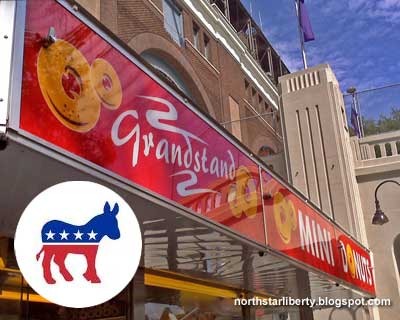
    Dollars to donuts (to DFL)


    It's State Fair time, and once again those clever entrepreneurs at Grandstand DFL Mini Donuts will be fundraising for DFL BPOUs in Ramsey County. And judging from the 2009 report filed by the donut stand PAC with the Minnesota Campaign & Finance Disclosure Board, the amounts of money donated to the DFL amount to much more than (ahem) peanuts:

    SD50 DFL: $6,950
    SD51 DFL: $2,800
    SD53 DFL: $9,700
    SD54 DFL: $12,500
    SD55 DFL: $6,950
    HD66B DFL: $11,100

    2009 Total Contributions to Party Units: $50,000.00, up 4% from 2008. That's a lot of bread, man.

    The Tenth Ward & Rural Ramsey DFL PAC is not required by the State Fair or any law to disclose at the booth itself where the proceeds from the sale of their deep-fried guilty pleasures are going. I'm not sure whether their sales would increase or decrease if they did. I just thought that you, dear readers, would like to know. Or as Rep. Laura Brod (R-New Prague) was quoted last session:
    “If you go to the State Fair and buy doughnuts at this booth, you think you’re buying doughnuts when, in actuality, what you’re doing is making a contribution to a political party of which you have no idea. You don’t know if you are donating to Republicans. You don’t know if you are donating to Democrats. You don’t know if you’re donating to defeat a ballot initiative.

    “I want them to know that they’re just not buying a doughnut. They are buying a philosophy along with it."

    Monday, August 23, 2010

    SD43 picnic fundraiser

    Please join me this Wednesday for SD43's event of the season! Share a barbecue picnic with the Republican Party of Minnesota slate of candidates, from SD43 to the statewide offices and Congress:

    U.S. Congressman Erik Paulsen, Tom Emmer for Governor, Pat Anderson for State Auditor, Dan Severson for Secretary of State, Chris Barden for Attorney General, SD43 candidate Norann Dillon, HD43A Rep. Sarah Anderson, and HD43B candidate Brian Grogan


    Date: Wednesday, August 25

    Catering by Famous Dave's
    Time: 5:30pm - 7:30pm
    5:30 pm Food served
    7:00 pm Program begins

    Cost: $15 Adults, $6 Children 6 and up, 5 and under FREE

    Where: Carlson Cheshire Park
    14440 Cheshire Parkway
    Minnetonka, MN

    Sponsored by Senate District 43 Republicans, Larry Thompson, chair.


    View Larger Map

    UPDATE: We had great weather and turnout for the SD43 picnic! Here are my photos from this event:


    Monday, August 16, 2010

    The wrong kind of change came to SD43


    In 2006-2007, a change in representation came to SD43. More than a change in name only, SD43 Sen. Terri Bonoff and HD43B Rep. John Benson radically changed how SD43 was represented on tax issues, according to data reported by the Taxpayers League of Minnesota. (The data for Benson is not missing in 2008, his score was zero in that year!) The question for voters in 2010 is: did constituent views really change that much, or has there been a disconnect between Bonoff and Benson and their Plymouth and Minnetonka districts?

    In contrast, HD43A Rep. Sarah Anderson's tax votes have shown continuity with her predecessor, current Hennepin County Commissioner Jeff Johnson. Have her constituents' views been represented in her votes on tax legislation?

    To put these years in context, in 2006 there was a growing discontent with Republicans, which apparently helped the DFL to win two of SD43's three open seats from the Republicans. 2008 was the Democrats' year with the election of Barack Obama. Since then, Obama's approval ratings have steadily declined, while the TEA Party movement has grown on the principles of limited government, lower taxes, and free markets. Rep. Benson won re-election in 2008, but Sen. Bonoff has not faced the voters since 2006.

    People vote (or don't vote) for a wide variety of reasons, but in 2010, as James Carville famously said, it's "the economy, stupid." This fall, with Minnesota's unemployment rate the second highest in the five-state area and Minnesota businesses relocating to more business-friendly states, SD43 voters should be asking Bonoff some tough questions about votes like these:
    • 2010: Bonoff voted to increase the state debt by $1 billion
    • 2010: Bonoff voted to approve $34 in additional debt for the Metropolitan Council
    • 2009: Bonoff voted in favor of a $330 million Senate bonding bill that was $130 million more than the House version, in a year when the state faced a $6 billion budget deficit
    • 2009: Bonoff voted in favor of the $4.3 billion transportation bill that included funding for various light rail and commuter rail projects, continuing the trend for rail funding over highways and road maintenance
    • 2009: Bonoff voted to override the Governor’s veto of a $1 billion tax increase, which included a new fourth tier income tax (the override failed)
    • 2008: Bonoff voted for a $6.6 billion tax increase that raised the gas tax, sales tax and vehicle registration tax, and created a new level of government in the Metro area to spend millions on transit boondoggles including the Central Corridor light rail line
    • 2008: Bonoff voted for a $1 billion pork-laden bonding bill that contained no funding for roads and bridges
    • 2007: Bonoff voted for the transportation bill, which raised taxes by billions of dollars, including a 50% increase in the gas tax, a wheelage tax, new sales taxes and higher license tab fees
    • 2007: Bonoff voted to pass the tax bill, which included tax increases, increased welfare to local units of government (LGA) and mandated automatic spending increases
    • 2006: Bonoff voted to raise taxes for stadiums, the arts, and the environment
    • 2006: Bonoff voted to have Minnesota taxpayers bail out the Minneapolis Teachers Retirement Fund to the tune of $1 billion
    Voting to increase taxes and accelerate runaway spending will not lead to increased employment and economic recovery (it hasn't yet); in fact, it won't even lead to increased tax revenue. Sen. Terri Bonoff's radical departure from past SD43 representation shows that she was the wrong kind of change for this district and wrong for Minnesota, especially in this economy.

    Thursday, August 12, 2010

    Norann Dillon knocks SD43 this Saturday

    SD43 challenger Norann Dillon will continue door knocking around SD43 this Saturday, with the assistance of members of the Minnesota Young Republicans. Dillon is such a tireless door-knocker, she must be on her second lap of the district by now.

    The YRs are working hard this election cycle across the state, particularly in CD3 where the "Blue to Red" campaign is targeting DFL incumbents, including SD43 Sen. Terri Bonoff. This year's YRs are party animals with a full event calendar, a snappy new web site, and abundant enthusiasm for commonsense and efficient government, lower taxes, and enjoying campaign activity with fellow Republicans.

    Monday, July 26, 2010

    What do the votes of incumbents reveal?


    If the only things you know about political candidates is what they tell you (about themselves and their opponents), and we presume that they will tell you only what they want you to hear, can you really call yourself an informed voter?

    That's why I like voting record scorecards. Typically, they list a large number of key bills and amendments that came before the state legislature or Congress and show how each and every legislator voted. Each vote is given a point value, and each elected official gets a score. A candidate can say anything on the campaign trail, but incumbents should live or die on their voting records.

    The specific bills chosen and whether a particular vote is considered "good" or "bad" depends on who's keeping score, yet the scores are objectively calculated in the same way for each legislator. Most voters don't have the time or expertise to track voting records by poring over the journals of the House or Senate over the course of several legislative sessions. Voting scorecards are a fast and methodical way to do your voter due diligence apart from the hue and cry of political parties and candidate campaigns.

    So how do SD43 incumbents and gubernatorial candidates fare on three right-leaning scorecards?

    Taxpayers League of Minnesota "Friends of the Taxpayer"
    • SD43 Sen. Terri Bonoff (DFL) - 2010: 25%, 2009: 8%, Lifetime: 22%
    • HD43A Rep. Sarah Anderson (R) - 2010: 87%, 2009: 87%, Lifetime: 81%
    • HD43B Rep. John Benson (DFL) - 2010: 6%, 2009: 7%, Lifetime: 9%
    • HD19B Rep. Tom Emmer (R) - 2010: 87%, 2009: 100% "Best Friend of the Taxpayer," Lifetime: 91%
    • HD60A Rep. Margaret Anderson Kelliher (DFL) 2010: 0%, 2009: 0%, Lifetime: 10%
    • HD64A Rep. Matt Entenza (DFL): 2006: 10%, Lifetime (2003-2006): 16%
    Minnesota Majority "Heroes and Zeros"
    • SD43 Sen. Terri Bonoff (DFL) - 2009: 11%, Career: 10%
    • HD43A Rep. Sarah Anderson (R) - 2009: 100% "Hero," Career: 94%
    • HD43B Rep. John Benson (DFL) - 2009: 0% "Zero," Career: 9%
    • HD19B Rep. Tom Emmer (R) - 2009: 100% "Hero," Career: 100%
    • HD50A Rep. Margaret Anderson Kelliher (DFL) - 2009: 0% "Zero," Career: 0%
    • HD64A Rep. Matt Entenza (DFL): (data unavailable prior to 2007)
    Bills and Votes
    • SD43 Sen. Terri Bonoff (DFL) - 2010: 27%
    • HD43A Rep. Sarah Anderson (R) - 2010: 86%
    • HD43B Rep. John Benson (DFL) - 2010: 13%
    • HD19B Rep. Tom Emmer (R) - 2010: 93%
    • HD50A Rep. Margaret Anderson Kelliher (DFL) - 2010: 12%
    • HD64A Rep. Matt Entenza (DFL): (2010 data only available)
    How did these legislators earn each of these scores? What does that tell you about them, given who is keeping score? Which legislators are best representing their districts? We'll look into the details in subsequent blog posts. You can play this game yourself by clicking on the scorecard links or by referring to the list of voting scorecards compiled by the nonpartisan Minnesota Legislative Reference Library.

    Share your favorite scorecards with us in the comments section.

    UPDATE: Taxpayers League scorecard updated with 2010 scores, which were just released.

    Wednesday, July 14, 2010

    Tip credit would boost employment

    This image was originally posted to Flickr by jasonlam at http://flickr.com/photos/93512023@N00/3397988457. It was reviewed on 06:15, 17 April 2009 (UTC) by the FlickreviewR robot and confirmed to be licensed under the terms of the cc-by-2.0.

    By Brian Grogan

    Recently, Republican candidate for Governor Tom Emmer spoke of the need for a law to relieve restaurant owners from paying the full minimum wage to employees who earn tips. Unfortunately, this debate has been misstated and it is hurting the many small-business restaurant owners who employ over 100,000 Minnesotans. The debate is not about minimum wage for servers but about government regulation and its unintended consequences on small businesses and jobs development.

    The mainstream media has been delinquent in reporting the full story. Prior to this story breaking, I had discussions with the Minnesota Restaurant Association and with real estate developers who specialize in developing restaurant properties. Both groups have expressed the frustration they have with a law in Minnesota that forces small business, restaurant owners to pay an additional 15-20 percent in fixed overhead costs.

    In particular, if a restaurant generates $1.5 million in revenues, an additional $200,000 to $300,000 in potential profits is spent paying wages to employees typically earning on average $13 or more per hour. Within a restaurant, a majority of the affected, higher paid employees are single, under 26 years old and do not have dependents. They are earning a great wage and a change to the law would not significantly change their annual wage compensation.

    Regionally, this law and added business cost is unique to Minnesota. Wisconsin, Iowa, South Dakota, North Dakota, and 39 other states do not force the higher wage cost on restaurants. This is a classic example of how regulations in Minnesota are hurting local businesses.

    One real estate developer commented that this law is directly related to the decision by a number of large, national restaurant franchises to cease opening new locations within the state of Minnesota. He estimates that this reflects a loss of as many as 15,000 new jobs in our state. And, this doesn’t account for the lost tax revenues and ancillary spending related to new construction and other wages.

    In addition, this law is negatively affecting many small business restaurant owners who today, due to a slow economy, are close to shutting their doors. In response to the adverse effect of this law, the Restaurant Association approached the Minnesota Senate during the 2010 legislative session and asked for relief.

    This is what the mainstream media is not telling you. Senator Kathy Saltzman, SD56, the Senate DFL majority whip, took up the cause for small business restaurant owners and authored the Restaurant Recovery Act. According to association leaders, it had fairly significant support within the senate and the likelihood of passage was looking good.

    Unfortunately, according to the restaurant association, the unions found out about the bill and used their political clout to make sure the bill never made it to the Senate floor for a final vote. What is significant is that the unions do not have a foothold within the restaurant industry, so not a single union job or wage would have ever been affected by the law.

    The DFL withdrew the bill. During the 2010 session, at a time of anemic jobs growth, Democrats were more concerned about pleasing the unions than passing legislation that would have spurred jobs growth and protected jobs.

    Did waiters and waitresses support this bill? Yes! During the bill’s hearing in committee, a significant number of waiters and waitresses spoke out and were present to show their support to their employers and the bill. They understand the difficulty their employers are having meeting payroll in this slow economy.

    This is a good debate because it is about government intervention within businesses and its unintended consequences, media biases, the union strangle hold on the DFL party and the loss of Minnesota jobs! If elected to the state House, I will introduce this legislation since I am more concerned about saving jobs and spurring jobs growth than pleasing union officials.

    Brian Grogan, Minnetonka, is running for the Minnesota House of Representatives in House District 43B.

    Thursday, July 08, 2010

    The forgotten man

    In a thought-provoking podcast interview, Walter Hudson (Fightin' Words blog) interviews Don Allen, an African-American North Minneapolis activist who feels that the Republican Party of Minnesota has for too long written off his neighborhood, and other DFL strongholds, like so much bad debt.

    Why doesn't the RPM have more boots on the ground in North Minneapolis, the University of Minnesota, or Lucky Rosenbloom's Dale Street neighborhood? (Rosenbloom should be one of Hudson's next one-hour interviews.) According to Allen, some folks in the urban core think that funding distributed by the city, state, and federal governments (and spent by school districts) should be more accountable and transparent (ahem, are you listening, Pat Anderson?), and that concerns about light rail transit's impact on neighborhoods are falling on deaf DFL ears.

    Allen thinks that conservative solutions to urban ills should be heard and discussed within his community. He has invited Republican officials to stop by his town hall meetings at the Sunnyside Cafe, but so far they have been no-shows. Allen wants Republican leadership, not just well-meaning twentysomething "outreach" coordinators, to begin cultivating relationships in his neighborhood.

    It will take more activists like Allen and candidates like Eva Ng, who ran for mayor of Saint Paul last year; Barry Hickethier, who is challenging Sen. Larry Pogemeiller (DFL-Minneapolis) in SD59; and Joel Demos, who is challenging Congressman Keith Ellison (D-MN5); running year after year, to plant conservative ideas and grow a GOP presence in the cities.

    As Hudson suggests, it will likely take more like a decade than an election cycle to change voting habits, and the RPM has some tough return-on-investment decisions to make with limited resources. But with that hopey-changey thing not working out so well, what better time than 2010 to get started?