Wednesday, August 13, 2008

Benson: your voice in Saint Paul?

Rep. John Benson (DFL-Minnetonka)Legislative scorecards can be a meaningful way to evaluate candidates for office. Find an interest group that tracks votes on issues you care about, and look up how your representative or senator voted.

One of the most important legislative issues, especially in a high-tax state like Minnesota, is taxes. The burden on Minnesota taxpayers increased by historic amounts last legislative session. So I looked to see how my state House member, Rep. John Benson (DFL-Minnetonka) fared on the two Taxpayers League of Minnesota scorecards issued during Benson's first term.

The verdict? Benson went from bad in 2007 to worse in 2008.

In 2007, Benson voted as a "friend of the taxpayer" on only three of twelve bills on the Taxpayers League scorecard. He voted the wrong way on the other ten bills, including:
  • Benson voted to override Gov. Pawlenty's veto of the 2007 transportation bill, which was overloaded with tax increases.
  • Benson voted in favor of the proposed constitutional amendment to increase the sales tax with dedicated funding for arts, entertainment, parks and public broadcasting.
  • Benson voted to reverse many welfare reforms and increase welfare spending in Minnesota.
  • Benson voted to mandate that 25% of Minnesota’s energy come from unproven renewable resources by 2025, increasing costs to consumers.
  • Benson voted in favor of the $334 million bonding bill which included millions of dollars in pork-barrel spending above the Governor’s recommendations.
  • Benson voted for billions of dollars in tax increases, including a 50% increase in the gas tax, a wheelage tax, new sales taxes and higher license tab fees.
  • Benson opposed a rule that would have required a 60% vote of the House to raise taxes.

Rep. Benson voted as a "friend of the taxpayer" on zero of eleven bills on the 2008 scorecard. Here is how Rep. Benson did nothing to moderate the spending spree with your money:

  • Benson voted to place a constitutional amendment before voters this November that would increase the state sales tax and dedicate this revenue to outdoor and "cultural heritage" programs. (You can still stop this tax increase by voting no on November 4.)
  • Benson voted in favor of the historic $6.6 billion tax increase contained in the transportation bill, and voted to override Gov. Pawlenty's veto of the bill.
  • Benson voted to balance the state budget by withdrawing $500 million from the state’s budget reserve while reducing spending by only $268 million.
  • Benson voted to raise the state minimum wage and index it to inflation, which would have made it even more difficult to conduct business in Minnesota — especially for small businesses. (This bill was vetoed by the governor.)
  • Benson voted with global warming extremists for a cap-and-trade system that would hurt Minnesota employers and eliminate jobs.

Whom do you think Rep. John Benson has better represented in the moderate Senate District 43? If you're a liberal Democrat, you're probably feeling well-represented. If you're a fiscal moderate-to-conservative, not so much.

Voters in HD 43B should visit candidate Brian Grogan's web site to find out how they can make a change for the better in 2008. Voters in other districts should use the Taxpayers League scorecard to ask some pointed questions of incumbents and challengers alike, and vote for change in November. As Taxpayers League of Minnesota President Phil Krinkie said, "We can't change the legislation that comes out of St. Paul until we change the legislators that we send to St. Paul."

Monday, August 11, 2008

SD 43 photo of the day

Left: "DRILL HERE, DRILL NOW, PAY LESS"

Right: "I ALREADY HAVE A SAVIOR, WHAT I NEED IS A PRESIDENT"

Wednesday, August 06, 2008

The Great Land, Part II

Alaska Governor Sarah Palin (R)Alaska's politics are a product of its nearly a century as a territory, during which it was exploited by a Congress in which it had no representation, and the rugged individuals who sparsely populate this "last frontier."
Although much of the economy is federally subsidized, "Bridge to Nowhere" notwithstanding, Alaska has a relatively flat governmental structure and a strong libertarian streak.

Most of Alaska has two levels of government: state and "borough," roughly equivalent to a county, but no township or city government, and as far as I know no regional transit boards or metropolitan councils. Much of the state falls into the "unorganized" borough and is administered by the state.

Firearms are licensed on a "shall issue" basis, and once licensed no additional license is needed to carry the weapon concealed. Carrying a firearm is illegal in Alaskan courthouses, schoolyards, bars and domestic violence shelters, but you don't see those ridiculous WEAPONS BANNED ON THESE PREMESES signs everywhere you turn as you do here in Minnesota. Alaska smoking laws resemble the pre-Indoor Clean Air Act era in Minnesota, with smoking and non-smoking sections in public places. Earlier this month, an Alaska Superior Court judge struck down a law that criminalizes the posession of up to an ounce of marijuana for personal use.

The state of Alaska does not have a state sales tax or state income tax. In some boroughs and cities there is a sales tax.

Alaskan politics has been known for its corrupt, good-old-boys ways, but its first female governor, the popular and photogenic Sarah Palin, has largely cleaned house since taking office in 2006. Palin, a lifetime member of the National Rifle Association, is the former mayor of Wasilla, 40 miles north of Anchorage (home of the Iditarod dog sled race). Her husband, Todd, works for BP at an oil field on the North Slope and is a commercial fisherman. Alaska's first family includes two sons and three daughters.

Friday, July 25, 2008

The Great Land

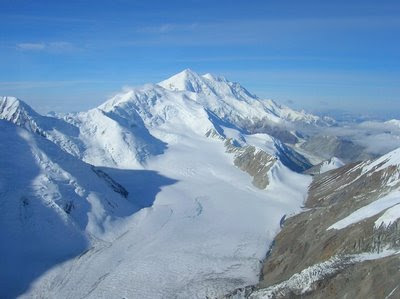
Mt. McKinley (photo: Matt Abe)We just got back from a two-week family vacation to Alaska. Alaska is unique among these United States for many reasons. Alaska is a huge state: it has over twice the area of Texas and has more land than all but 18 of the Earth's sovereign nations. Alaska remained a territory for over 90 years (it celebrates its 50th anniversary of statehood next year), during which time Congress used Alaska's lack of representation in that body to its extreme advantage (to put it politely).
(For more on Alaska's fight for statehood, I highly recommend reading "Let us end American colonialism," former Alaskan territorial governor Ernest Gruening's cogent 1955 speech to the Alaska Constitutional Convention, which was recently published by the Anchorage Press, an alternative newspaper similar to City Pages but not as caustically liberal.)

Thanks to a lack of federal funding while the continental U.S. was being criss-crossed with railroads, Interstate Highways, seaports, and airports, most of the highways that exist in Alaska today are two-lane highways, and many areas (including the state capital at Juneau) are accessible only by air or water. Some roads are closed entirely during the winter.

A fortunate unintended consequence of constricting settlement and commerce in Alaska before statehood in 1959 is that to this day, Alaska remains largely undeveloped and untamed, a rustic and often spectacular living postcard at every turn for residents and tourists to enjoy. The state population is only 670,053 (2006), and only a handful of towns have over 10,000 population. Only 1% of the land in Alaska is privately owned (an area that is a little larger than the state of Connecticut). The rest is managed by the Federal and state governments, and Native groups.

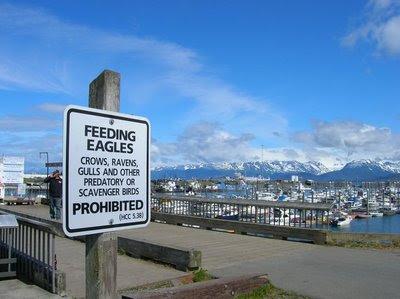
Homer, AK (photo: Matt Abe)Outside of Anchorage or Fairbanks, you won't find many big box retailers or franchises, light rail or stadiums, or even too many gas stations — just small towns, small businesses, campgrounds, fishing charters and guide services, glaciers, tiny espresso drive-thrus, a few volcanoes, and friendly people.

Most Alaskans like it that way. On a flightseeing trip over Mount McKinley (see photo), we saw many lake homes that are accessible only by seaplane, and perhaps by snowmobile or dog sled in the winter. Before statehood, white settlers and adventurers learned the art of dog sledding and pioneered bush aviation into remote areas. Native Alaskans (please don't call them "eskimos") still practice subsistence hunting and traditional ways of thriving in the land in which they feel chosen to live, while selectively adopting Western ways to preserve their way of life.

Alaska is derived from a native Aleut word, Alyeska, meaning "The Great Land." It's a remarkable and uniquely American place with a politics all its own, which I will discuss in my next post.

Tuesday, July 22, 2008

All of the above

Oil, natural gas, and wind energy baron T. Boone Pickens testified today to the U.S. Senate on moving from foreign sources of oil to, well, natural gas and wind energy. We are certainly too dependent on oil from unfriendly nations, and renewable energy should be pursued and used where it makes sense, but some of Pickens' testimony caused me to pause.

"I have to think in 10 years, the demand for oil — because the price now is going up — in 10 years, you're going to have $300 oil. Maybe higher, I don't know," said Pickens, as quoted by Fox News.

Unless the law of supply and demand is repealed (which the government regularly attempts to do with taxes and subsidies), isn't there a point at which the demand for oil will eventually hit a peak and decline, stabilizing the price of oil? Of course, with the government and environmental groups restricting the oil supply with a moratorium on both oil exploration and construction of refineries and pipelines, I suppose that the market price for oil could settle at $300 a barrel, even with reduced demand. And with mandates for seasonal, "boutique" blends of gasoline, corn ethanol subsidies, and ever-higher gas taxes, government is exacerbating the rising prices at the retail level.

Either way, at this point government is not the solution to our problem, government is the problem. As Congresswoman Michele Bachmann (MN-6) suggested on her recent trip to the National Renewable Energy Laboratory in Colorado and the Alaskan National Wildlife Refuge, America needs an "all of the above" approach to solving its energy challenges: environmentally-responsible domestic exploration and production of fossil fuels, nuclear power, conservation, and research into renewable energy. The quickest way toward energy independence is for government to get out of the way and let private industry and free markets work.

Saturday, July 19, 2008

Credentialed

I have been granted "special press" credentials to cover the 2008 Republican National Convention on North Star Liberty. This will get me into the Xcel Energy Center, just not on the delegate floor. How many days I will actually be in on scene in Saint Paul will depend on my schedule at work. I would love to interview you if you are Minnesota delegate, and I would love to hear your story ideas.

Tuesday, July 01, 2008

The nanny party in Denver

If you really want to know the difference between how Democrats and Republicans govern, all you need to do is take a look at some of the machinations underway for the Democratic National Convention. They can't even trust their own delegates to make politically-correct choices about what to eat during the convention. As reported in the June 25 Wall Street Journal:
But Matt Burns, a spokesman for the Republican convention, looks on with undisguised glee at some of the Democrats' efforts -- such as the "lean 'n' green" catering guidelines.

Among them: No fried food. And, on the theory that nutritious food is more vibrant, each meal should include "at least three of the following colors: red, green, yellow, blue/purple, and white." (Garnishes don't count.) At least 70% of ingredients should be organic or grown locally, to minimize emissions from fuel burned during transportation. "One would think," says Mr. Burns, "that the Democrats in Denver have bigger fish to bake -- they have ruled out frying already -- than mandating color-coordinated pretzel platters."

Laura Hylton, general manager of Biscuits & Berries catering, agrees in principle. But she has been testing her recipes using local ingredients for weeks and still can't get the green peppercorn sauce right when she uses white Colorado wine. The state's high-altitude wine industry took off in the early 1990s and produces some award-winning labels, but Ms. Hylton says diplomatically, "It's a little...lacking. Our wineries out here aren't what you'd see in California or France."

Joanne Katz, who runs the Denver caterer Three Tomatoes, will take one for the green team by removing her fried goat-cheese won tons with chipotle pepper caramel sauce from the menu. But she questions whether some of the guidelines will have the desired earth-saving effects.

According to at least one Democrat blogger, this sort of kooky puritanism is leaving centrist Dems squirming under nanny-state correctness:

…this is EXACTLY why my beloved Democratic Party loses elections. The various factions that make up our party spend so much time trying to ensure that each one of their core principles is thrust upon Americans with little or no choice. After all ‘we’ know ‘better.’ … this information only adds to the perception that Democrats care more about engineering society in a politically correct fashion, than we do about helping working families put food on the table.

Monday, June 30, 2008

Strib: drill here, drill now, pay less

Well, they wouldn't quite go all the way to ANWR, but it was still refreshing for the Star Tribune, like Sen. Norm Coleman (R-MN), to take one step toward the center on the question of increasing domestic exploration for and production of fossil fuels. Excerpts from the Sunday editorial:
While there are good reasons ANWR should remain off limits, there are also good reasons to reconsider the nation's offshore oil deposits, where drilling and exploration have long been banned thanks to a 1982 congressional moratorium and a 1990 executive order by President George H.W. Bush. Off-limits coastal areas are estimated by the U.S. Department of the Interior to hold close to 19 billion barrels of recoverable oil, as well as substantial supplies of natural gas. By some estimates, the oil available is the equivalent of about a decade's worth of U.S. oil production -- not enough to end import dependence but enough to smooth the nation's transition to renewable fuels.

Much has changed since the 1982 moratorium. Though some environmental advocates dispute this, drilling technology has advanced over the past quarter-century. Oil companies can drill more efficiently in deeper water with significantly less risk to the environment...exploring these coastal areas could have an immediate impact at the pump. Just the possibility that domestic oil supplies are expanding likely would deter speculators, sending prices down.

As a nation, we must push forward to a future in which clean, renewable energy fuels cars and heats homes. But there's a long way to go. In the meantime, breaking the backs of consumers and industry still dependent on fossil fuels is unacceptable. Relief is needed.

I enjoy biking, camping, hiking, and canoeing, and I believe that we are called to be good stewards of the earth. The marketplace will greatly reward the entrepreneurs who bring alternative energy products to market. It will happen, but in the meantime, our economy will be crippled if we fail to make use of the rich resources that lie right now beneath our feet. And that would be a bad thing for the whole earth.

Monday, June 23, 2008

Frank Weir (1935-2008)

Frank Weir (photo: 3rd CD Republicans)
From the 3rd Congressional District Republicans:
We sadly report that our dear friend, Frank Weir, Former Chair of SD 43, passed away on June 21st. He is survived by his wonderful wife Anne, and their two daughters, grandchildren, siblings, nieces, and nephews. Frank was not only a Republican community leader but lived and believed in community service. During his lifetime Frank served on school boards, Rotary, Plymouth Planning Commission, Peace Lutheran Church committees, and was a volunteer fireman and policeman. Frank will be sadly missed by all of us. Our sorrow is strengthened knowing that Frank is now at peace.

Service is Wednesday, 11 AM at the Peace Lutheran Church, 3695 Country Road 101, Plymouth, MN 55446. Visitation Tuesday 5-8 pm and 1 hour prior to service on Wednesday at the church.

Frank Weir was there when I attended my first SD 43 precinct caucus, through good years and bad, always with an easy smile. Although he missed this year's precinct caucus while in the hospital after his "farewell" trip back east where he was from, he was there at Erik Paulsen's kick-off rally, with his usual smile like nothing happened. At this year's Hennepin County endorsing convention, Frank was honored by the Third Congressional District Executive Committee for his years of party service.

It's difficult to imagine this year's election cycle without Frank, but I'm sure he would have an equally difficult time understanding why: he would just want us to get on with winning elections.

Thursday, June 19, 2008

Behind closed doors

After the pundits at the TwinWest Chamber of Commerce's June 6 panel discussion (at the Doubletree Park Place hotel in St. Louis Park) generally agreed that "a lot got done" at this year's legislative session, they also agreed on a less sanguine development:
"The lack of transparency in the process I think is very, very unfortunate," [Taxpayers League of Minnesota president Phil] Krinkie said.

Added moderator Mary Lahammer of Twin Cities Public Television, "I have never been a part of a more angry and frustrated press corps. There was extreme anger and frustration about how much happened behind closed doors."

Lahammer said the governor's press secretary accused her of stalking Pawlenty after she took a picture of him through a window as negotiations progressed.

"No governor gives a rip" if the press corps is upset, [Politics In Minnesota publisher Sarah] Janecek responded, although she agreed, "It really is amazing because everything really did get decided behind closed doors."

Media-driven, backroom politics has come to Minnesota, said panelist Blois Olson, executive vice president of public relations firm Tunheim Partners and a DFL commentator.

("TwinWest panelists consider politics in Minnesota," Sun Newspapers, June 13, 2008)

Laws and sausages are made behind closed doors for a reason. Some persons become vegetarians after touring a meat packing plant. I'm guessing that the rest of the story about this year's session won't be revealed until after November, if at all.