Showing posts with label alaska. Show all posts

Wednesday, August 06, 2008

The Great Land, Part II

Alaska Governor Sarah Palin (R)Alaska's politics are a product of its nearly a century as a territory, during which it was exploited by a Congress in which it had no representation, and the rugged individuals who sparsely populate this "last frontier."

Although much of the economy is federally subsidized, "Bridge to Nowhere" notwithstanding, Alaska has a relatively flat governmental structure and a strong libertarian streak.

Most of Alaska has two levels of government: state and "borough," roughly equivalent to a county, but no township or city government, and as far as I know no regional transit boards or metropolitan councils. Much of the state falls into the "unorganized" borough and is administered by the state.

Firearms are licensed on a "shall issue" basis, and once licensed no additional license is needed to carry the weapon concealed. Carrying a firearm is illegal in Alaskan courthouses, schoolyards, bars and domestic violence shelters, but you don't see those ridiculous WEAPONS BANNED ON THESE PREMESES signs everywhere you turn as you do here in Minnesota. Alaska smoking laws resemble the pre-Indoor Clean Air Act era in Minnesota, with smoking and non-smoking sections in public places. Earlier this month, an Alaska Superior Court judge struck down a law that criminalizes the posession of up to an ounce of marijuana for personal use.

The state of Alaska does not have a state sales tax or state income tax. In some boroughs and cities there is a sales tax.

Alaskan politics has been known for its corrupt, good-old-boys ways, but its first female governor, the popular and photogenic Sarah Palin, has largely cleaned house since taking office in 2006. Palin, a lifetime member of the National Rifle Association, is the former mayor of Wasilla, 40 miles north of Anchorage (home of the Iditarod dog sled race). Her husband, Todd, works for BP at an oil field on the North Slope and is a commercial fisherman. Alaska's first family includes two sons and three daughters.
Friday, July 25, 2008

The Great Land

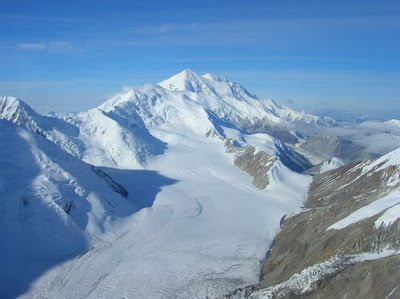
Mt. McKinley (photo: Matt Abe)We just got back from a two-week family vacation to Alaska. Alaska is unique among these United States for many reasons. Alaska is a huge state: it has over twice the area of Texas and has more land than all but 18 of the Earth's sovereign nations. Alaska remained a territory for over 90 years (it celebrates its 50th anniversary of statehood next year), during which time Congress used Alaska's lack of representation in that body to its extreme advantage (to put it politely).
(For more on Alaska's fight for statehood, I highly recommend reading "Let us end American colonialism," former Alaskan territorial governor Ernest Gruening's cogent 1955 speech to the Alaska Constitutional Convention, which was recently published by the Anchorage Press, an alternative newspaper similar to City Pages but not as caustically liberal.)

Thanks to a lack of federal funding while the continental U.S. was being criss-crossed with railroads, Interstate Highways, seaports, and airports, most of the highways that exist in Alaska today are two-lane highways, and many areas (including the state capital at Juneau) are accessible only by air or water. Some roads are closed entirely during the winter.

A fortunate unintended consequence of constricting settlement and commerce in Alaska before statehood in 1959 is that to this day, Alaska remains largely undeveloped and untamed, a rustic and often spectacular living postcard at every turn for residents and tourists to enjoy. The state population is only 670,053 (2006), and only a handful of towns have over 10,000 population. Only 1% of the land in Alaska is privately owned (an area that is a little larger than the state of Connecticut). The rest is managed by the Federal and state governments, and Native groups.

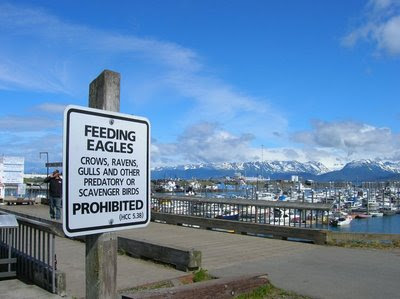
Homer, AK (photo: Matt Abe)Outside of Anchorage or Fairbanks, you won't find many big box retailers or franchises, light rail or stadiums, or even too many gas stations — just small towns, small businesses, campgrounds, fishing charters and guide services, glaciers, tiny espresso drive-thrus, a few volcanoes, and friendly people.

Most Alaskans like it that way. On a flightseeing trip over Mount McKinley (see photo), we saw many lake homes that are accessible only by seaplane, and perhaps by snowmobile or dog sled in the winter. Before statehood, white settlers and adventurers learned the art of dog sledding and pioneered bush aviation into remote areas. Native Alaskans (please don't call them "eskimos") still practice subsistence hunting and traditional ways of thriving in the land in which they feel chosen to live, while selectively adopting Western ways to preserve their way of life.

Alaska is derived from a native Aleut word, Alyeska, meaning "The Great Land." It's a remarkable and uniquely American place with a politics all its own, which I will discuss in my next post.

Tuesday, July 22, 2008

All of the above

Oil, natural gas, and wind energy baron T. Boone Pickens testified today to the U.S. Senate on moving from foreign sources of oil to, well, natural gas and wind energy. We are certainly too dependent on oil from unfriendly nations, and renewable energy should be pursued and used where it makes sense, but some of Pickens' testimony caused me to pause.

"I have to think in 10 years, the demand for oil — because the price now is going up — in 10 years, you're going to have $300 oil. Maybe higher, I don't know," said Pickens, as quoted by Fox News.

Unless the law of supply and demand is repealed (which the government regularly attempts to do with taxes and subsidies), isn't there a point at which the demand for oil will eventually hit a peak and decline, stabilizing the price of oil? Of course, with the government and environmental groups restricting the oil supply with a moratorium on both oil exploration and construction of refineries and pipelines, I suppose that the market price for oil could settle at $300 a barrel, even with reduced demand. And with mandates for seasonal, "boutique" blends of gasoline, corn ethanol subsidies, and ever-higher gas taxes, government is exacerbating the rising prices at the retail level.

Either way, at this point government is not the solution to our problem, government is the problem. As Congresswoman Michele Bachmann (MN-6) suggested on her recent trip to the National Renewable Energy Laboratory in Colorado and the Alaskan National Wildlife Refuge, America needs an "all of the above" approach to solving its energy challenges: environmentally-responsible domestic exploration and production of fossil fuels, nuclear power, conservation, and research into renewable energy. The quickest way toward energy independence is for government to get out of the way and let private industry and free markets work.