Showing posts with label iraq. Show all posts

Monday, September 17, 2007

"We love freedom, how 'bout you?!"


Conservatives don't quite have a knack for protest marches, like the left does.

On Saturday, I joined a group of around twenty conservative bloggers and activists at a counterdemonstration to the Women Against Military Madness (WAMM) anti-war protest march. Most estimates put the WAMM crowd at approximately 1500, which sounds about right to me. The marchers started at the Saint Paul Cathedral, then took a hard right turn (how apropos) onto Kellogg Avenue to the Xcel Energy Center, site of the 2008 Republican National Convention, and then doubled back to the State Capitol.


As in a football game in which the final score doesn't tell the full story, you can't judge the success or failure of this event by the lopsided turnout. I spoke with one WAMM marcher who was disappointed by the turnout on her side.


Both sides looked at Saturday's event at least in part as a practice run for next year's Republican National Convention, at which the left is gearing up to stage a major protest action — which some fear could turn violent. Conservative bloggers are referring to this group of protesters as "anarkids," a combination of "anarchy" and their ostensible twenty-something average age.

A pair of anti-war bicyclists challenge the conservative counterprotest at Saturday's WAMM march

But Saturday's event was for the most part peaceful. There were the two female bicyclists who had a pointed conversation with one of our group (see photo), the trio of military veterans against the war who were respectfully but firmly challenged by Navy vet Swiftee, and the tall, slim ranting guy with a shaved head whose verbal attack on Leo nearly drew an intervention from a mounted patrol of Saint Paul's finest. Then were the two women dressed from head to toe in red feathers.


The WAMM pre-march rally featured several speakers and the obilgatory series of rhyming chants ("No War For Oil," etc.). Rainbow gay pride kites and banners flew high, which was an ironic scene at a Catholic cathedral.

We were encouraged before the march began by the many motorists who honked, clapped, and waved at us as they drove by. The left definitely has the organizations, the coalitions, and the individuals who seem to be energized by the street theater of political protest en masse. The right is much more into working the political process by lobbying, campaigning, and writing. This day reminded me of the demonstrations outside the gubernatorial debate at the Fitzgerald Theatre last fall: a bunch of activists shouting at each other. Maybe next time I'll just wander around with my video camera like Eva Young did, in search of some interesting interviews. If I get around to it, I'll upload my video of the march itself for your viewing pleasure.


True North, the new conservative collaborative blog that sponsored the counterdemonstration, has aggregated much more coverage of the event. Don't miss the brief video of Swiftee sweetly taunting the marchers with "Bin Laden thanks you!"

Monday, July 30, 2007

Finally, facts top ideology in Iraq news coverage

I'm not a conspiracy theorist, but I've noticed that the anti-President Bush mass news media's Iraq coverage has taken a noticable turn toward the center over the last few days, away from the simplistic "Out of Iraq now" chant of the far left:

Wednesday, July 25: "Reality Check: Withdrawing from Iraq" by Pat Kessler, WCCO-TV. Kessler explains why any withdrawal from Iraq would be "complicated and dangerous."
The Pentagon said it will take a good year to safely bring home troops, transport equipment and move support personnel. At the same time, 50,000 civilians working for private contractors will also depart, leaving Iraqis behind amid certain chaos and violence.

There's MORE. More than 2 million Iraqi refugees have already fled, with most going to Syria and Jordan. Two million more are displaced within Iraq.

When U.S. troops leave, humanitarian groups say hundreds of thousands of Iraqis may try to leave also to avoid bloodshed, creating a refugee crisis.

Saturday, July 28: "Iraq withdrawal: five difficult questions," by Bill Marsh, New York Times. An abridged version ran in Saturday's StarTribune; see the Times web site for the full text. Marsh examines five practical questions of a withdrawal:


1. How Fast Can the Troops [physically] Leave? "Large numbers of American soldiers have left a modern war zone, but never so many from a still-hostile region."


2. Can Departing Soldiers Be Shielded From Attack? "Troops concentrated in convoys that are transporting huge quantities of supplies out of Iraq make tempting targets...Withdraw with casualties now, or risk a better exit in a few years? How great is that risk?"


3. What to Take? What to Leave? What to Destroy? "'The faster you move out, the more you have to leave behind or destroy,' said Mr. Cordesman of the Center for Strategic and International Studies. 'There’s no ideal.' Voters and political candidates, he says, are looking for a quick-exit 'fantasy.'"


4. How Long to Repair and Ship Vital Equipment? "At the end of their duty, sophisticated combat aircraft aren’t simply loaded on to ships bound for the United States. They must be thoroughly washed of sand and contaminants until sterile, then shrinkwrapped to protect them from sea air. 'Everything has to be cleaned and pass an agricultural inspection," said William G. Pagonis, a retired three-star Army general who directed logistics in the 1991 Persian Gulf war. 'It’s not an easy task.'"


5. Who Stays Behind? "There are up to 100,000 Iraqi contractors, perhaps more, working for the United States. After a pullout, many of them could be at risk from reprisals by anti-American forces."


Sunday, July 29: "Sounding off: Iraq veterans look back," by Curt Brown and Mark Brunswick, StarTribune. Minnesota National Guard troops returning from their 16-month deployment in Iraq tell it like it is, and amazingly, most of the stories published are supportive of U.S. presence in Iraq. Check out the web site for audio clips of these soldiers' stories in their own words.


Monday, July 30: "A War We Might Just Win," by Michael E. O'Hanlon and Kenneth M. Pollack, New York Times. Excerpts:

Here is the most important thing Americans need to understand: We are finally getting somewhere in Iraq, at least in military terms.

Today, morale is high. The soldiers and marines told us they feel that they now have a superb commander in Gen. David Petraeus; they are confident in his strategy, they see real results, and they feel now they have the numbers needed to make a real difference.

In war, sometimes it’s important to pick the right adversary, and in Iraq we seem to have done so. A major factor in the sudden change in American fortunes has been the outpouring of popular animus against Al Qaeda and other Salafist groups, as well as (to a lesser extent) against Moktada al-Sadr’s Mahdi Army.

How much longer should American troops keep fighting and dying to build a new Iraq while Iraqi leaders fail to do their part? And how much longer can we wear down our forces in this mission? These haunting questions underscore the reality that the surge cannot go on forever. But there is enough good happening on the battlefields of Iraq today that Congress should plan on sustaining the effort at least into 2008.

Friday, July 20, 2007

Thank you for your service, Red Bulls

1/34th Red Bulls patchThe Minnesota National Guard 1st Brigade Combat Team, 34th Infantry Division (1/34th BCT, in military parlance) has proudly returned home to Minnesota. The 1/34th web site concisely summarizes the "Red Bulls's" amazing tour of duty in Iraq:
The 1/34 BCT conducted its Transfer of Authority ceremony with the 1/82 BCT(A) at the Ziggurat of Ur on 11 July 2007, ending another chapter in Red Bull history.

During the longest deployment of any unit to date in Operation Iraqi Freedom, they drove 2.4 million miles with 99% on time starts;

discovered a significant number of IEDs before they could detonate;

achieved a 98% vehicle readiness rate;

processed 1.5 million vehicles at entry control points without incident;

completed $29 million in Iraqi reconstruction (seven water plants, 90 miles of road, numerous schools, and hundreds of miles of roadside cleanup);

closed eight redundant radio relay points and improved the remaining three;

and provided $55 million in force protection improvements for four bases.

1/34th BCT has earned the Operation Iraqi Freedom Campaign Streamer for its service in Iraq from March 2006 to July 2007.
Transfer of Authority, July 11, 2007 (Photo: redbullweb.com)

Fortunately, these brave soldiers will be helped in significant ways after the yellow ribbons come down:

After experiencing the intensity of combat, Minnesota Guardsmen will reunite with their families and resume their civilian lives. The Minnesota National Guard, under the leadership of men like Maj.Gen. Larry Shellito, Col.Kevin Gerdes and Chaplain John Morris, have developed a unique combat veteran reintegration program in hopes of changing the way soldiers and airmen are reintegrated into their communities.

The "Beyond the Yellow Ribbon" program has proven an effective means to prepare every combat veteran and his family for a safe, healthy and successful reintegration following deployment.

"As a 25-year veteran of the Marine Corps, I remember the joys and difficulties of coming home from deployment," [Minnesota Congressman Rep. John] Kline said. "Minnesota’s 'Beyond the Yellow Ribbon' includes extensive reintegration efforts, and Minnesotans can be proud of this pioneering program. I was pleased to work with the National Guard Bureau and the Minnesota National Guard to introduce legislation that would create a national program.”[1]

If you enjoy your freedom in America, thank a Red Bull or any veteran. Well done, Red Bulls, and welcome home!

UPDATE: Congratulations to MOB member The Patriette on the homecoming of her favorite member of the 1/34th Red Bulls: her husband! Tune in to her blog for details!

Friday, April 20, 2007

Patriots Day 2007: "This war is lost"


"This war is lost, and the surge is not accomplishing anything as indicated by the extreme violence in Iraq." —U.S. Senate Majority Leader Harry Reid, April 19, 2007

On April 19, 1775, the American patriots confronted British troops at Lexington and Concord, firing the "shot heard round the world" that began the American Revolution. You can read the first stanza of Emerson's poem, Concord Hymn, at the base of the famous Minuteman statue in Concord, Massachusetts:
By the rude bridge that arched the flood,
Their flag to April's breeze unfurled;
Here once the embattled farmers stood;
And fired the shot heard round the world.

We have a support-the-troops ministry at my church, which recently sent care packages of magazines, puzzle books, and other nice tokens to let our military sons, daughters, grandchildren, and friends know that we are thinking of and praying for them. Here is an excerpt from the thank-you note we received from one of the recipients, a U.S. Marine named Andrea:

Thank you very much for the care package you sent me. It was very thoughtful and much appreciated. It is comforting to know so many people are thinking and praying for me and all the other troops out here. Life in Baghdad has been very interesting since I first came here at the beginning of December. I have enjoyed being here during the historic events such as the Saddam trial and execution, the appointment of General Petraeus and the departure of the US Ambassador of Iraq. Please continue your support of the troops as well as the war in Iraq. We are doing great things out here, never forget those who have died for this war. We must and will be victorious. Our nation depends on it.

It just about kills me to know that Andrea and all of our solidiers, sailors, airmen, and Marines heard or will soon hear Sen. Reid's Patriot Day statement, and that more of our kids in school will hear it than Emerson's Concord Hymn.

Thursday, February 15, 2007

Ramstad, Kline disagree on vote of "no confidence"

Is a vote of "no confidence" really a good idea in a time of war?

In parliamentary systems, votes of no confidence may be the first step to removing a prime minister or dissolving parliament. In our democratic republic, we have votes of confidence or no confidence by the entire electorate every election cycle.

House Concurrent Resolution 63, disapproving of the decision of the President to deploy more than 20,000 additional United States combat troops to Iraq, is an American version of the parliamentary vote of no confidence. My U.S. Representative from MN-3, Jim Ramstad, spoke in favor of the resolution:
As General Colin Powell, one of the most respected military leaders of our generation, put it, a surge was already tried in Baghdad last fall, and it failed...

It's time for Congress to step up and express our strong support of our brave troops, our continued support of their original mission and our opposition to the increase of U.S. troops to police a civil war in Iraq.
President Bush's new strategy is more than a troop surge. Bush intends to: let the Iraqis lead; help Iraqis protect the population; isolate extremists; create space for political progress; diversify political and economic efforts; and situate the strategy in a regional approach. Ramstad's phrase "police a civil war" is something we would expect to hear from liberals like Wendy Wilde or Al Franken.

Rep. John Kline (MN-6) sees the resolution for what it is: Congressional micromanagement à la the Vietnam war. In a thoughtful and thorough statement on the floor of the U.S. House, Kline said:
One critic of the administration's handling of Iraq, a very vocal critic, and a man who I knew and admired throughout my Marine Corps career, retired General Anthony Zinni, the former commander of Central Command, spelled it out bluntly when he noted that, "We cannot simply pull out, as much as we may want to. The consequences of a destabilized and chaotic Iraq sitting in the center of a critical region in the world could have catastrophic implications."

...Let us not promote a humanitarian disaster which is almost unimaginable. Let us support success in Iraq. Let us support the new commander in Iraq and give him what he needs to succeed in this mission.
Ramstad is one of the most patriotic, pro-troop people anywhere. While not what I would call conservative, he works hard for his district and the Republican Party. I see him across the Third District every Memorial Day, from a mid-morning American Legion ceremony in a tiny Wayzata cemetery to the flag-draped, spit-and-polish observance at Fort Snelling National Cemetery. And I will be forever grateful for his principled vote against No Child Left Behind, in spite of bone-breaking arm twisting from the Bush White House. But I question whether a vote of no confidence in a time of war is truly in the best interests of freedom and our country.

Monday, January 29, 2007

We're not giving up and we're not going away

President Bush could be taking a cue (probably unbeknownst to him) from Shar in Minneapolis, that tenacious opponent of public subsidies for millionaire baseball players and billionaire baseball team owners.

Shar and her anti-stadium tax group are known for their slogan, "We're not giving up and we're not going away." This is exactly the message that those darn terrorist insurgents in Iraq (and by extension, extremists worldwide) need to hear.

As I was trying to catch up on reading my back issues of The Weekly Standard over the weekend, I was pleased to learn that troop surges work. Not only do they work, they have worked in Iraq — twice:
Between November 2004 and February 2005, according to the Brookings Institution's Iraq Index, the number of coalition soldiers in Iraq rose by 18,000. In that time, the number of Iraqi civilians killed fell by two-thirds, and the number of American troops wounded fell by three-fourths. The soldiers were soon pulled out; by the summer of 2005, American and Iraqi casualties rose again. Later that year, the same thing happened again. Between September and November of 2005, another 23,000 soldiers were deployed in Iraq; once again, both Iraqi and American casualties fell. In the early months of 2006, the number of soldiers fell again, and casualties spiraled up. ("Doubling Down in Iraq," by William J. Stuntz, The Weekly Standard, November 20, 2006)
There is even evidence that the latest surge is already producing results, even before it has begun.

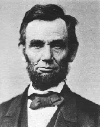
President Abraham LincolnHistory, all the way back to Sun-Tzu, indicates that when the enemy preceives that he can't win, he surrenders. The tactics have changed, but the strategy endures. Abraham Lincoln understood this (as the Stuntz story continues):
In a speech delivered a month after his reelection, Lincoln carefully surveyed the North's resources and manpower and concluded that the nation's wealth was "unexhausted and, as we believe, inexhaustible." Southern soldiers began to desert in droves. Through the long, bloody summer and fall of 1864, the South had hung on only because of the belief that the North might tire of the conflict. But Lincoln did not tire. Instead, he doubled the bet — and won the war.
This is not rocket science. Remember Malone's (played by Sean Connery) advice to Elliot Ness (Kevin Costner) in The Untouchables?
Malone: If you open the can on these worms you must be prepared to go all the way because they're not gonna give up the fight until one of you is dead.

Ness: How do you do it then?

Malone: You wanna know how you do it? Here's how, they pull a knife, you pull a gun. He sends one of yours to the hospital, you send one of his to the morgue. That's the Chicago way, and that's how you get Capone!
This time, let's clear and hold Baghdad, so the Iraqi political process can work. Give Petraeus a chance. If the enemy understands that we are not giving up and we are not going away until he is pacified, freedom for the Iraqis, and security for the United States, will win. If the Democrats succeed in their nostalgic remake of the forfeit of the Vietnam war, then it truly will be an apocalypse now.