Friday, September 18, 2009

A Constitution Day primer

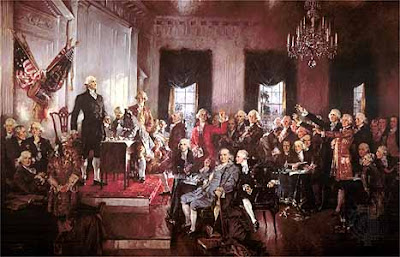
Scene at the Signing of the Constitution of the United States by Howard Chandler Christy
by Marjorie Holsten

In 1787, our young country faced serious problems including bitter division between states, a deeply depressed economy, and high inflation. The Continental Congress operating under the Articles of Confederation called for a convention of delegates (quote) "to devise such further provisions as shall appear to them necessary to render the constitution of the Federal Government adequate to the exigencies of the Union." There were no limits placed on the authority of this convention.

On May 25, 1787 a quorum of delegates met in Independence Hall in Pennsylvania, the same hall where just over a decade earlier 8 of these delegates had signed the Declaration of Independence, birthing our nation.

George Washington was elected president of the convention.

Early on, the men realized that mere revisions to the Articles of Confederation would not be sufficient to solve the nation’s serious problems. America had experienced tyranny under Great Britain with a government that was too powerful. America had also experienced anarchy under the Articles of Confederation with a weak and ineffective government.

To establish a balance between these extremes, these Godly men decided to create a whole new form of government: A Constitutional Republic. They stated their six goals in the Preamble of the Constitution, as follows:

We the People of the United States

1. in Order to form a more perfect Union,
2. establish Justice,
3. insure domestic Tranquility,
4. provide for the common defense,
5. promote the general Welfare, and
6. secure the Blessings of Liberty to ourselves and our Posterity,

do ordain and establish this Constitution for the United States of America.

The founders knew America needed three equal branches of government, with checks and balances so that no one branch became too powerful. For four long, hot months they debated and discussed every detail of the new Constitution, including casting more than 60 ballots solely on the issue of how a president should be elected. They debated the Virginia Plan, the New Jersey Plan, and the Connecticut Compromise.

During one particularly difficult time, Benjamin Franklin, then 81, said "I have lived, sir, a long time, and, the longer I live, the more convincing proofs I see of this truth--that God governs in the affairs of men. And if a sparrow cannot fall to the ground without his notice, is it probable that an empire can rise without his aid? We have been assured, sir, in the sacred writings, that 'Except the Lord build the house, they labor in vain that build it.' I therefore beg leave to move that, henceforth, prayers imploring the assistance of Heaven, and its blessings on our deliberations, be held in this assembly every morning before we proceed to business, and that one or more of the clergy of this city be requested to officiate in that service."

Form that time forward, the Founding Fathers prayed together daily and read the Bible. 34% of all citations during deliberations came from the Bible.

Thomas Jefferson was our Ambassador to France during the Constitutional Convention. He had no part in writing the Constitution. He didn’t write the phrase “Wall of separation between church and state” until 1802 in his letter to the Danbury Baptists. This phrase does NOT exist in our Constitution! The founders who prayed together in the State House clearly did not intend their document to be used to outlaw religion in the public arena.

Finally, on September 17, 1787, 222 years ago today, 39 of the 55 delegates signed the new constitution. Eleven days later, the Continental Congress unanimously approved the new Constitution without any changes and sent it to the states for ratification.

Many states raised objections at their ratifying conventions. Congress encouraged the states to ratify the body of the constitution and attach suggested amendments. The states did just that, attaching 189 Amendments. At the next session of Congress, James Madison distilled these down to 12 amendments, of which ten were finally approved and ratified by the states. These are known collectively as the Bill of Rights and use language such as “Congress shall make NO LAW respecting an establishment of religion…” “The right of the people to keep and bear arms SHALL NOT be infringed, and” the right of the people to be secure in their houses SHALL NOT be violated.”

Patrick Henry said, “The Constitution is not an instrument for the government to restrain the people, it is an instrument for the people to restrain the government."

The Constitution went into effect March 4, 1789. The first national "Thanksgiving Day" was originally created by George Washington in November of 1789 as a way of "giving thanks" for our Constitution.

Our constitution, article by article

This brilliant document, bathed in prayer, consists of a Preamble, 7 Articles, and 27 Amendments.

Article 1 governs the organization and powers of Congress. Section eight contains a list of 18 clauses, each with a specific duty of Congress. The first Clause is the “General Welfare Clause,” which states “Congress shall have the power to lay and collect taxes… for the general welfare of the United States….

There are 17 more clauses in Section 8 enumerating specific duties of congress – we call these the enumerated powers. If the Founding Fathers had intended Congress to have unlimited authority, they would not have written specified additional duties after creating a “general welfare” clause. Clearly the founders intended to have limits on Congressional authority.

When you read the list, you will see that the enumerated powers do NOT include
  • the power to take over private companies

  • the power to bail out failing companies

  • the power to take over health care

  • the power to regulate what is taught in classrooms.

There is a name for actions taken without Constitutional authority: UNCONSTITUTIONAL.

Article 2 deals with the Executive Branch of government and provides that “No person except a natural born Citizen shall be eligible to the Office of the President.” The current President has not produced a valid birth certificate proving his eligibility. He has spent significantly more than a million dollars fighting attempts to require that he produce one. On January 21st, 2009, his very first day in office, Obama signed Executive Order 13489 sealing his records.

Article 3 deals with the Judicial Branch and establishes the Supreme Court of the United States. The judicial branch does NOT have legislative or policy-making authority – only congress composed of elected officials can make laws. When the court oversteps its bounds, we have Judicial Tyranny.

Article 4 contains provisions relating to the states, including the Full Faith and Credit Clause. Under this clause, the marriage I entered into with my husband in Minnesota many years ago is to be honored in all 50 states. The founding fathers never intended this clause to be a foundation for gay marriage across America.

Article 5 provides the rules for amending the Constitution. If our founding fathers had intended the Constitution to be a “living, breathing document, there would be no need to amend it. We do NOT have a living Constitution. If a provision of the Constitution is unclear, one is discern the original intent of the founding fathers. More than 15,000 records from the convention exist today. It is not hard to discern the intent of these God-fearing men. One thing is clear: Our founders NEVER intended the Constitution to allow the murder of 50 million babies.

Article 6 provides that the Constitution is the Supreme Law of the Land. This means that Supreme Court justices are NOT to look at international law when they interpret OUR Constitution.

Lastly, Article 7 provides the rules for the original ratification of the Constitution.

I challenge every one of you to read the Constitution.

To conclude, I would like to quote the 30th president of the United States, Calvin Coolidge, who said “To live under the American Constitution is the greatest political privilege that was ever accorded to the human race.”

We the People, may God Bless you!

Attorney Marjorie Holsten delivered this speech at the Constitution Day Tea Party, September 17, 2009, at the Minnesota State Capitol. Holsten is a wife, mother, and attorney. She homeschools her children and teaches Constitutional Law to many homeschoolers. Ms. Holsten is president of 10-PACK: Politically Active Conservative Kids campaigning in 2010. She can be reached at marjholsten@yahoo.com.

See the National Constitution Day web site, sponsored by the National Constitution Center, for much more information, and learning resources for K-12 students, about the Constitution.

Thursday, September 17, 2009

Americans still believe in Constitutional principles

We the People of the United States, in Order to form a more perfect Union, establish Justice, insure domestic Tranquility, provide for the common defence, promote the general Welfare, and secure the Blessings of Liberty to ourselves and our Posterity, do ordain and establish this Constitution for the United States of America. —Preamble to the Constitution of the United States of America

On September 17, 1787, the Constitution of the United States of America was ratified by the delegates to the Constitutional Convention. "It is encouraging to see the principles enshrined in the Constitution over 222 years ago are as essential to Americans today as they were when we were initially fighting for those fundamental liberties," said National Constitution Center President and CEO Linda E. Johnson.

When asked which of the following statements comes closest to their view, 75% of respondents to a recent National Constitution Center/Associated Press poll chose "The United States Constitution is an enduring document that remains relevant today," while only 23% chose "The United States Constitution is an outdated document that needs to be modernized."

Poll respondents also endorsed the principle of the balance of powers. When asked, "If you thought it would help improve the economy would you favor or oppose giving the President more power at the expense of the power of Congress and the courts?," 75% would oppose, while only 24% would be in favor.

Americans also still favor private property and free enterprise. Poll respondents strongly oppose allowing the government to take partial ownership of private enterprise, even if it would prevent them from going out of business (71%) or losing jobs (66%), or if the failure of the industry would seriously harm the economy (60%).

Wednesday, September 09, 2009

Health care lessons for America

A Canadian doctor has some very important lessons to teach Americans pondering health care reform, while a local think tank has succinctly presented its health care reform ideas based on principles of individual freedom, personal responsibility, economic freedom, and limited government.

The observations of Lee Kurisko, M.D., were published in his recent article, "What America Needs to Learn from Canadian Medicare," in the Summer 2009 issue of the Journal of American Physicians and Surgeons.

"As a Canadian physician practicing in the U.S.," observes Dr. Kurisko, "I am confident that the systemic problems in American medicine pale in comparison with those of Canada...It is astonishing to discover that some Americans see Canada's system of government-delivered universal health care as a utopian solution to systemic medical services delivery problems in the U.S."

Dr. Kurisko's main points:
  • Central planning does not work - "Stodgy, clunky bureaucracies cannot possibly meet patients’ needs in the way the marketplace does in almost every other economic sector."

  • Price controls do not work - "With insufficient compensation for their time, effort, or investment of capital, doctors had a disincentive to provide services."

  • Whoever controls the dollars is boss [or, as I like to say, "Who pays the piper calls the tune."] - "To paraphrase economist Milton Friedman, in free societies generally people get what they want. In government-controlled societies, people get what a bureaucrat says they may have."

  • Medical care is not a "right" - "A 'right to health care' implies that someone has to provide it. But what of the liberty rights of physicians, nurses, and other medical workers? Or the property rights of taxpayers and entrepreneurs?"

  • People can be persuaded to accept poor care - "Despite their professed individualism, however, Americans quietly accept statist programs like Social Security that have dangerously large unfunded liabilities. They also accept public education and its lackluster results...There is no reason to believe that Americans will not also be seduced and willingly come to embrace more government medicine."

  • There are major similarities between Canadian and American medicine - "Both systems rely on third-party payment with its escalation of demand."

The Freedom Foundation of Minnesota has issued a new report, "Prognosis for National Health Insurance: A Minnesota Perspective." It quantifies the cost to Minnesotans of the $1 trillion health reforms proposed by President Obama and Congress. As an alternative to this massive spending (and debt) increase, the report makes recommendations such as:

  • Provide for individual ownership of insurance policies. The tax deduction that allows employers to purchase your insurance should instead be given to the individual.

  • Better leverage Health Savings Accounts (HSAs) to empower individuals to monitor their health care costs and create incentives for individuals to use on necessary services.

  • Allow interstate purchasing of insurance. Policies in some states are more affordable because they include fewer “bells and whistles”. Consumers should be empowered to decide which benefits they need and what prices they are willing to pay.

  • Reduce the number of mandated benefits insurers must cover, empowering consumers to choose which benefits they need is only effective if insurers are able to fill these needs.

  • Eliminate unnecessary scope-of-practice laws and allow non-physician health care professionals to practice to the extent of their education and training. Retail clinics have shown that increasing the provider pool safely increases competition and access to care and empowers the patient to decide from whom they receive their care.

  • Reform tort liability laws. Defensive medicine needlessly drives up medical costs and creates an adversarial relationship between doctors and patients.

Monday, September 07, 2009

State fair photoblog

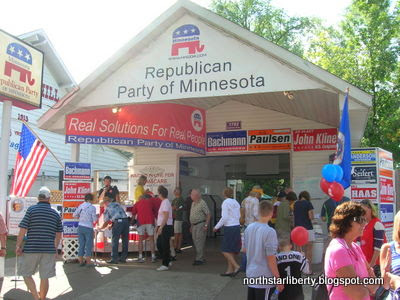
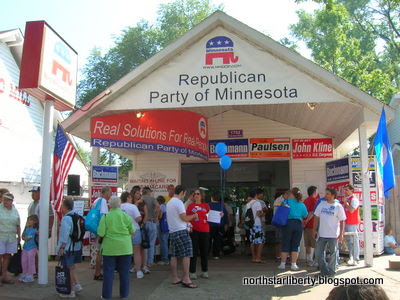
Here are my morning and afternoon images of the Minnesota DFL (few visitors) and GOP (crowded) booths at the 2009 Minnesota State Fair, which ends today.

MN DFL booth, morning

MN DFL booth, afternoon

MN GOP booth, morning

MN GOP booth, afternoon

Friday, August 28, 2009

Donuts for donkeys

Donuts for donkeys: Grandstand Mini Donuts, operated by the Tenth Ward & Rural Ramsey DFL
Top reasons to avoid Grandstand Mini Donuts at the Minnesota State Fair:
  1. 54 calories per donut
  2. 27 calories from fat per donut
  3. 6 g total carbohydrate per donut
  4. Undisclosed contribution per bag to the Tenth Ward & Rural Ramsey DFL Political Action Committee (PAC)

Now that the Great Minnesota Get-Together is underway, it's a good time to recall Mitch Berg's report that Grandstand Mini Donuts, located outside the Grandstand, is a stealth fundraising booth for a DFL PAC that in 2008 donated $45,000 among six DFL Senate Districts, courtesy of some unsuspecting fairgoers (many among whom likely were Republicans!).

The State Fair does not require that vendors publicly disclose where their proceeds are going, but why wouldn't Grandstand Mini Donuts do so? As a public service, you could print out a few copies of the two-page Campaign Finance and Public Disclosure Board filing Schedule B2 (last two pages of this PDF file), and just happen to post them somewhere nearby!

Thursday, August 20, 2009

Gubernatorial hopefuls meet at SD43 picnic

SD43 gubernatorial candidates picnic (photo: SD43)Gubernatorial hopefuls at SD43 picnic with Rep. Sarah Anderson (center, holding microphone). Photo: SD43

Monday evening, six hopefuls for the Minnesota GOP endorsement for governor broke bread, gave stump speeches, and answered questions in Plymouth on their statewide tour of Republican summer picnics. According to the SD43 Republicans, about 250 gathered at picnic tables and lawn chairs, around a shelter decorated with red, white, and blue bunting, to hear the candidates, gossip about politics over barbecue sandwiches, and watch the kids play nearby.


Die-hard conservatives won't have just one candidate to line up behind, as in 2002 with west metro favorite son Brian Sullivan, or Sue Jeffers in 2006, we will have to choose from several dedicated, well-spoken, proven public servants (maybe we can send two of them into the general election —as governor and lieutenant governor, that is?).


Some of the stars of the minority caucuses in the state Senate and House, and a star of the Pawlenty administration, appeared at the picnic: former minority leader Rep. Marty Seifert (R-Marshall), third-term Rep. Tom Emmer (R-Delano), former assistant minority leader Sen. David Hann (R-Eden Prairie), and former state auditor Pat Anderson.


Seifert proved his mettle as House minority leader again this session, effectively holding his caucus together and working with Governor Pawlenty. Hann is a stalwart, principled conservative. Emmer's no-nonsense, forceful "gimme a break" style would serve him well in campaign debates and negotiations with the legislature. Anderson has a proven record of reform as state auditor and commissioner of Employee Relations, which she merged into the Department of Finance (thereby shrinking government and eliminating her own job). All have unquestionable conservative reform records.


Also stumping in Plymouth for the endorsement were Sen. Mike Jungbauer (R-East Bethel), former Rep. Bill Haas, and Phil Herwig. Compared to the previous candidates, they are at a disadvantage in name recognition, experience, and star power to get endorsed and elected.


From now until the endorsement, there are going to be many of these events happening around the state (see the True North calendar for details). I encourage you to attend. They are lots of fun, and enable you to effectively put that post-TEA Party energy into winning hearts, minds, and elections.


Picnic table notes


I had the good fortune of sharing a picnic table with Glenn Ray, one of the proprietors of the Minnesota Prager Discussion Group blog, which is widely followed among Minnesota conservatives. Ray is an outspoken, thoughtful old gent (I mean that as a compliment!) with cogent political and ideological insights: think a west metro Craig Westover. He provided a running commentary to me during the stump speeches and Q&A; it would have made a great liveblog.


Visiting from SD33 were Sen. Gen Olson (R-Minnetrista) and Rep. Connie Doepke (R-Orono) (pronounced DEP-key: the "O" is silent). Before I got in line for the dinner buffet, I learned from Doepke how the Republicans in the Legislature executed a successful minority strategy, while the DFL majority was frequently at intramural loggerheads thanks to Speaker of the House Margaret Anderson Kelliher and Senate Majority Leader Larry Pogemiller. Doepke also warned that next session, the DFL will have a strategy for Gov. Pawlenty's 2009 unallotment gambit. ("Fool me once, shame on you; fool me twice, shame on me.")


Pat Anderson must have been on her way to another important event, because she left the picnic after delivering her speech, and she was wearing a striking gubernatorial power suit with some snazzy heels, not unlike another certain female, former suburban mayor, state commissioner, and cold-weather state governor we know!


After the candidates spoke, I looked for the sign-up table or booth run by Big Insurance, Big Pharama, or other "special interest groups" for town hall meeting disruption actions. I am tiring of showing up to protests as an unpaid concerned citizen, and am looking to make some extra money to help pay for TARP, the American Recovery and Reinvestment Act, Cash for Clunkers, cap-and-trade, and federal health insurance reform (that is, in addition to Medicaid, Medicare, state Medical Assistance, state General Assistance Medical Care (GAMC), MinnesotaCare, and Hennepin County's various medical assistance programs, which I am already paying for!). When I asked around to see if anyone else was getting paid to be an "astroturf" protester, I was told I would have to "join a union."

Monday, August 17, 2009

Sound and fury

"If you get hit, we will punch back twice as hard." —Deputy White House chief of staff Jim Messina in a town hall strategy briefing on August 6, with senior White House adviser David Axelrod, to Democrat Senators

"The America I know and love is not one in which my parents or my baby with Down Syndrome will have to stand in front of Obama’s 'death panel' so his bureaucrats can decide, based on a subjective judgment of their 'level of productivity in society,' whether they are worthy of health care. Such a system is downright evil." —Sarah Palin on Facebook

What good are town hall meetings, anyway? They seem to bring out the most extreme elements on both sides, heighten emotions, and sometimes end in fistcuffs and trips to jail or the emergency room. They are routinely scripted by organizers and disrupted by protesters. In this age of Internet communication, aren't town hall meetings antiquated?

I know from attending my share of school board, city council, and legislative hearings over the years that there is a public comment continuum. Legislative hearings are strictly controlled by the committee chair, time limits on testimony are enforced, and questions from committee members can resemble cross-examination at trial (indeed, many legislators have law degrees). School board and city council meetings are usually less formal to encourage citizen participation, but there are still time and parliamentary limits. These meetings all generally occur in capitols, school district offices, and city halls.

The public comment portion of legislative or Congressional town hall meetings out in the community tend to be the loosest type of exchanges, and most often attract members of the general public who are inexperienced at the niceties of addressing the chair or even speaking in public at all. When there are hot-button issues on the table, as with Minnesota's academic standards a few years ago, public funding for the Twins stadium, smoking bans, and the current health reform debate, these meetings attract the media, organized testimony and demonstrators, and often more heat than light.

Although certainly not effective as a workshop for crafting good public policy, public hearings and town hall meetings are a traditional and necessary component of our American experiment in self-government that is of the people, by the people, and for the people. There is something quintessentially American about an elected official, whether from the local school board or the United States Senate, standing up in front of a school gymnasium full of his constituents to receive both praise and brickbats.

As someone observed during one of yesterday's Sunday interview shows, some politicians may love President Obama's vision for health care, but they love getting reelected even more. Town hall meetings, e-mail, social networking, and talk radio are all ways that the hoi polloi are participating in the political process like never before. Witness Sarah Palin's use of Facebook:
One can hardly deny that Palin's reference to "death panels" was inflammatory. But another way of putting that is that it was vivid and attention-getting. Level-headed liberal commentators who favor more government in health care, including Slate's Mickey Kaus and the Washington Post's Charles Lane, have argued that the end-of-life provision in the bill is problematic--acknowledging in effect (and, in Kaus's case, in so many words) that Palin had a point.

"Palin Wins," Wall Street Journal, August 14, 2009

Although anyone can send an e-mail or write a letter, professional lobbyists and interest groups tend to drown out the voices of John and Jane Q. Public. Elected officials can become isolated in their Greek-columned worlds, especially in Washington, D.C. They have numerous procedural and security methods for preserving order at town hall meetings without stifling public comment. This face-to-face conduit between constituents and representatives is still needed in our republic, if we are to keep it.

Monday, August 03, 2009

Mike Pence: back to basics

Rep. Mike Pence (photo: US House of Representatives)If the GOP has lost its way, people like Rep. Mike Pence (R-IN6) are trying to steer it back on course. Republicans across the country should consider his remarks on yesterday's Fox News Sunday:
...government handouts through a government bureaucracy is no substitute for broad-based tax relief and fiscal discipline in Washington, D.C.

...the quickest way to get money into this economy is not to take it in the first place.

...I think Republicans are starting to earn back the confidence of the American people that we squandered, really, in the last 10 years. I mean, look, let's be honest. We didn't just lose our majorities in 2006. We lost our way. I mean, the American people saw a Republican Party that walked away from its commitment to fiscal discipline, limited government and reform, and the American people walked away from us.

We saw -- we saw in the last Republican administration, you know, increase at the federal Department of Education, the Medicare prescription drug entitlement, and an administration that ended up taking $700 billion in bad decisions on Wall Street and transferring those to Main Street, that on top of a doubling of the national debt.

But since the last election, Republicans on Capitol Hill are returning to their commitment to fiscal discipline, limited government and reform, and the defense of traditional values.

And I believe we're -- we're beginning to get a second look from the American people, and they're beginning to see that Republicans are returning to the principles that minted our majority in 1980 and again in 1994.

...I don't think the debate in this country is about President Obama or about Democrats or Republicans. I think it's about who we are as a nation. I think it's about what we believe is the proper role of government in our lives and the proper responsibility of individuals. ...Republicans for a while were on the wrong side of that argument. We've gotten back on the side of fiscal responsibility, personal responsibility, limited government.

And I think as we continue to fight consistently on Capitol Hill and take our message to the American people, the American people are going to come back to us.

Thursday, July 23, 2009

When pigs fly

Papa John Kolstad (photo: John R. Kolstad)Politics makes strange bedfellows. —Charles Dudley Warner

People used to use the expression "when they send a man to the moon" as a way of saying, "it will never happen." Then they did send a man to the moon, several actually. Some used the expression, "when a black man is elected President of the United States," then that happened too.

You would think that "when Papa John Kolstad runs for office as a Republican" would never happen. Well, it seems, it's gonna happen.

As reported by Mitch Berg in Shot in the Dark, and First Ringer at Truth v. The Machine, the Minneapolis City Republican Committee endorsed musician, businessman, and political activist Kolstad for mayor of Minneapolis last Saturday. Kolstad was also endorsed for mayor by the Independence Party of Minnesota on Monday.

This is not your father's Republican candidate. In his DFL endorsement speech for a state senate seat in 2000, he said, "It has troubled me, as it has so many others, that we are experiencing the failure of the three pillars of democracy — the elected officials, the media, and the courts — to protect the public interest."

(Oops, he forgot about free markets, limited government, and the right to bear arms!)

When Kolstad ran as the Green Party endorsed candidate for Minnesota Attorney General in 2006, he promised that as AG he would fight any efforts by private insurance companies to block the creation of state-run "single payer" health insurance.

According to the Minnesota Independent, "Kolstad has long been frustrated by the centrist tendencies of the DFL." (Huh?)

Has Kolstad suddenly made a sharp turn starboard (not likely), or have the last Republicans in Minneapolis turned hard to port? My first reaction was that Kolstad and his Green Party cronies decided to co-opt the Republican endorsement to advance their agenda. (This is not an unheard-of tactic in the political game where there is a weak or non-existent opposition party organization.) Some of my fellow conservatives felt a mixture of shock, embarrassment, and rage at the endorsement.

Nik Ludwig, chair of the Minneapolis City Republican Committee (certainly one of the most thankless political jobs in the state), told me in an e-mail that Kolstad's endorsement speech "talked a lot about reducing taxes, reducing regulations on small business, eliminating wasteful spending, auditing the city books, and restoring economic opportunity in the city." (I have asked for a transcript.) As for political credentials, Ludwig said that Kolstad beat the other endorsement candidates in "political experience, civic involvement and advocacy, and obviously name recognition."

As only Nixon could go to China, maybe only Kolstad could win as a Republican in Minneapolis. Kolstad could wage a highly-visible, nonpartisan campaign that paints Rybak's city hall as wasteful and unfriendly to small business (like the message of Eva Ng's campaign for mayor of Saint Paul). That in itself could win friends and influence people, and cause more Minneapolitans to take a second look at the GOP.

Perhaps "the enemy of my enemy is my friend," but if Kolstad wins (a possibility with instant runoff voting), would he really follow through by cutting taxes and regulation, and increasing the responsiveness and transparency of Mill City government?

Stranger things have happened.