Saturday, December 24, 2011

Merry Christmas My Friend

Merry Christmas to our Armed Forces and Semper Fi to all United States Marines serving around the world to keep us free.

Merry Christmas My Friend


by Marine Lance Corporal James M. Schmidt (1986)

Twas the night before Christmas, he lived all alone,
In a one bedroom house made of plaster and stone.

I had come down the chimney, with presents to give
and to see just who in this home did live.

As I looked all about, a strange sight I did see,
no tinsel, no presents, not even a tree.
No stocking by the fire, just boots filled with sand.
On the wall hung pictures of a far distant land.

With medals and badges, awards of all kind,
a sobering thought soon came to my mind.
For this house was different, unlike any I'd seen.
This was the home of a U.S. Marine.

I'd heard stories about them, I had to see more,
so I walked down the hall and pushed open the door.
And there he lay sleeping, silent, alone,
Curled up on the floor in his one-bedroom home.

He seemed so gentle, his face so serene,
Not how I pictured a U.S. Marine.
Was this the hero, of whom I’d just read?
Curled up in his poncho, a floor for his bed?

His head was clean-shaven, his weathered face tan.
I soon understood, this was more than a man.
For I realized the families that I saw that night,
owed their lives to these men, who were willing to fight.

Soon around the Nation, the children would play,
And grown-ups would celebrate on a bright Christmas day.
They all enjoyed freedom, each month and all year,
because of Marines like this one lying here.

I couldn’t help wonder how many lay alone,
on a cold Christmas Eve, in a land far from home.
Just the very thought brought a tear to my eye.
I dropped to my knees and I started to cry.

He must have awoken, for I heard a rough voice,
"Santa, don't cry, this life is my choice
I fight for freedom, I don't ask for more.
My life is my God, my country, my Corps."

With that he rolled over, drifted off into sleep,
I couldn't control it, I continued to weep.

I watched him for hours, so silent and still.
I noticed he shivered from the cold night's chill.
So I took off my jacket, the one made of red,
and covered this Marine from his toes to his head.
Then I put on his T-shirt of scarlet and gold,
with an eagle, globe and anchor emblazoned so bold.
And although it barely fit me, I began to swell with pride,
and for one shining moment, I was Marine Corps deep inside.

I didn't want to leave him so quiet in the night,
this guardian of honor so willing to fight.
But half asleep he rolled over, and in a voice clean and pure,
said "Carry on, Santa, it's Christmas Day, all secure."
One look at my watch and I knew he was right,
Merry Christmas my friend, Semper Fi and goodnight.

Friday, December 16, 2011

Face time

Wednesday evening I had the pleasure of tipping a pint of Schell's Snowstorm with thirty or so of some of my closest friends — closest to me politically, anyway — over at O'Gara's Bar and Grill in Saint Paul. Activist Laura Gatz had convened a Christmas party of the conservative social group Red, Right and Brew, providing a great excuse to belly up to the bar and hobnob with my fellow politicos for a few hours.

As I entered the crowded bar area, I greeted fellow blogger Bridget Sutton (Another Everyday Wonderwoman). Blogger (Shot in the Dark) and talk radio host Mitch Berg held court at the "fun table," which is pretty much at whichever table Mitch is currently seated. At one point I was the only one in our little corner of O'Garas who had never hosted a radio show. We opined with former gubernatorial endorsement candidate and current talk radio host Sue Jeffers about the Republican Party of Minnesota's State Central Committee meeting (December 31) to select its next chairman. Mara from the SW Metro Tea Party told us about her group's regular meetings, which include independents, people new to politics, and some Ron Paul supporters.

Dan McGrath of Minnesota Majority discussed with me the recent temporary restraining order blocking the vote ordered by Governor Mark Dayton to unionize the state's home-based childcare providers. Just getting this far has been very expensive, and it will take a lot more to pursue a permanent injunction to stop unionization of and government intrusion into home daycare businesses, which Childcare Freedom says have increased what parents pay for childcare an average of 35% in other states that have unionized independent childcare providers. Please consider a donation of any amount to help. If a only small minority of providers is allowed to vote and it passes, union dues and "fair share" fees (forced union dues from union non-members) will create a war chest that could push union activity to childcare centers next, and parents will be wondering, "How did this happen?"

Anthony Hernandez, who hopes to win the Minnesota Republican endorsement for U.S. Senate and unseat Sen. Amy Klobuchar, stopped by the "fun table" to introduce himself and his fiancée, and discuss his campaign. Hernandez ran unsuccessfully for the state Senate in SD64 (Saint Paul) last year, against an entrenched incumbent and strong DFL presence, but he is convinced that conservatives can find common ground with independents and even some Democrats by communicating in non-ideological, practical terms.

I wish that I had more time to hear Minneapolis-born Lynne Torgerson talk about her bid to unseat Fifth District Congressman Keith Ellison, but fortunately she left a few campaign business cards behind.

Online communication is a wonderful networking tool, but activists need to get face time with each other and do some old fashioned socializing and networking on a regular basis, not just at precinct caucuses and conventions.

The SD45 Republicans do a great job of meeting one Saturday morning every month at a local bagel shop for informal conversation and networking (and make effective use of their website and social media). The Red, Right, and Brew happy hours do a great job of bringing together Republicans and like-minded non-Republicans and independents, and sometimes candidates and elected officials. Tea Party groups across Minnesota are also meeting to discuss politics. Find a group that suits you, and get some face time on a regular basis. Doing so will move you off the bench and into the game, and the entire team will benefit.


Tuesday, December 13, 2011

Occupy Wall Street is only a prelude to 2012


The future of American political discourse, particularly the 2012 elections, is Occupy Wall Street and the tactics of Saul Alinsky's 1971 book, Rules for Radicals. For example, at a recent campaign appearance, Rep. Michele Bachmann (R-MN) was a victim of Alinsky's tactic #13:

Pick the target, freeze it, personalize it, and polarize it.

Bachmann, her campaign, and even her staff and supporters going back to her first campaign for the Minnesota state Senate are by now also very familiar with these Alinsky tactics:
  • Ridicule is man’s most potent weapon.
  • Keep the pressure on with different tactics, and actions, and utilize all events of the period for your purpose.
  • The major premise for tactics is the development of operations that will maintain a constant pressure upon the opposition.
The recent "mic check," the "glitter bomb," "penny dump," and the old cream-pie-in-the-face are all examples of these tactics. So are the attack blogs against Bachmann and former vice presidential candidate Sarah Palin. Remember, the Republican Party hasn't even endorsed a candidate yet. These recent actions are just warm-ups. We ain't seen nothin' yet.

For more on how the left and the Obama campaign uses Alinsky's tactics, follow the Alinsky Defeater's Blog.

Friday, November 11, 2011

Go For Broke!

Speaker of the United States House of Representatives John Boehner presents a Congressional Gold Medal during a ceremony in honor of Japanese-American veterans of the 100th Infantry Battalion, the 442nd Regimental Combat Team, and the Military Intelligence Service. These units served with distinction during World War II. November 2, 2011. Photo: Speaker of the House John Boehner. Creative Commons CC BY-NC

November 2 was a proud day for me as an American of Japanese ancestry, and as an American period. On that historic day, the Congress of the United States awarded its highest honor, the Congressional Gold Medal, collectively to three World War II-era units of the U.S. military: the Army's 100th Batallion, 442nd Regimental Combat Team, and the Military Intelligence Service. The valor in combat of the 100th/442nd has already made them the most decorated units in Army history, but these awards are significant for another reason.

As Speaker of the House John Boehner put it, the Japanese Americans of my dad's generation fought "a two-fronted battle of discrimination at home and fascism abroad" with an enthusiasm reflected in their motto, "Go For Broke." They met the virulent racism of the day with an unshakable patriotism and a heroic defense of the very country that forcibly interned them and their families for years, without due process, presumption of innocence, and other protections of the Constitution.

The 100th/442nd/MIS stand with other segregated military units like the Tuskegee Airmen and the Montford Point Marines as shining examples of what it means to be an American, even when some of their fellow Americans considered them unworthy of the title. Over sixty years later, we still live in an imperfect country, but it is still the last best hope on Earth.

Friday, November 04, 2011

Conservatively speaking

Speaking at the Center of the American Experiment Fall Briefing at Orchestra Hall on October 26, former Florida Governor Jeb Bush outlined four major policy areas that he feels must be advanced in order to turn around this country's economic crisis:
  • Strong, two-parent families that provide stability and enable success for our children
  • Streamlined, common-sense business regulation that achieves results, not simply grows the bureaucracy
  • Domestic and Canadian sources of energy that free our economy from control by unfriendly nations
  • Education that enables our workers to compete globally, instead of producing the same results at higher and higher costs
One attendee commented before Bush's speech that he didn't know there were enough conservatives in all of Minnesota to fill the Orchestra Hall lobby (this event proved that there are). The evening's discussions were emphatic without being partisan or even overly ideological. It helped that Bush is not running for office, and that the Center calls itself conservative and non-partisan.

Attendees picked up printed copies of Senior Fellow Katherine Kersten's white paper "Preparing All Minnesota Children to Read by Third Grade," which was one of Florida's recent education reforms and was stated as a "goal" by the Minnesota state education omnibus finance bill that was passed this past session. Learning to read by third grade has been called critical by education experts, who say that after third grade, pupils begin to read to learn. Many pupils who don't learn to read by third grade struggle for the rest of their academic careers. Since 2003, when Florida began to require third-graders to read before being promoted to fourth grade, the number of third-graders scoring below this standard has fallen 41 percent. Middle school reading scores there have also risen significantly since 2006, when this cohort entered middle school.

The Center's president, Mitch Pearlstein, introduced his new book, From Family Collapse to America's Decline: The Educational, Economic, and Social Costs of Family Fragmentation. The book echoes Jeb Bush's first policy priority. Education scholar Chester Finn said, "Parents are the first and most influential teachers that any child has and the family the first and most influential school. When those are in good shape and to their part, kids tend to fare well in education and in life. When those falter, great schools (and other key institutions) can help a lot—but never really substitute. Understanding—and trying to reverse—America's 'nuclear meltdown' is this thoughtful book's peerless contribution."

Public policy events like this are good venues for discussing the issues of the day outside the context of legislative strategy or election-year politics. Minnesota's Center of the American Experiment is a national bastion of conservative solutions.

Monday, September 19, 2011

Ten years later, a new hope

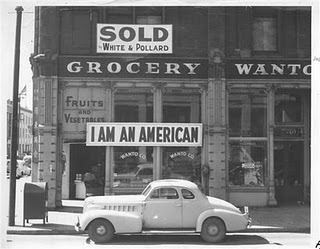
A large sign reading "I am an American" placed in the window of a store, at 13th and Franklin streets, on December 8, the day after Pearl Harbor. The store was closed following orders to persons of Japanese descent to evacuate from certain West Coast areas. The owner, a University of California graduate, will be housed with hundreds of evacuees in War Relocation Authority centers for the duration of the war.
Photo by Dorothea Lange, 1942
Most every day, but especially on September 11, we remember the attacks on the United States and the horrific loss of life and property that occurred in 2001. Even ten years later, many wonder whether we will ever be safe against Islamic extremism.

A letter to the editor in Saturday's Star Tribune from a Muslim American gave me hope. I found it remarkably similar to the feelings and frustrations expressed by other American immigrant groups. The path to peace from the pain of 9/11 is a uniquely American one, and it is one we have traveled before. In this case, I am encouraged that it is a path that many Muslim Americans have already begun.

Seventy years ago, in the face of virulent racism, stereotypes, bigotry, and worse, Japanese Americans set out to prove to their neighbors and their country that being an American is not a matter of race, it's a matter of allegiance to the Constitution and American values like hard work, helping each other, and playing by the rules. Dorothea Lange's photo of a store on December 8, 1941, is iconic. The owner, a graduate of the University of California, Berkeley, was subsequently sent to an internment camp along with 110,000 other West Coast Japanese aliens and "non-aliens" (a clever euphemism for United States citizens).

A large group of American Muslims are quietly and individually living the American way of life, while unapologetically retaining the core tenets of their faith. Many of them are your neighbors. A letter to the Plymouth Sun Sailor put it succinctly (excerpt):
Recent letters lay out a false claim that Muslims are anti-American. This is absolutely false. I am a moderate, peace-loving Muslim and a patriot.

Yes, Muslim fanatics exist. But is it not true there are Christian fanatics? The IRA, for example. Is it not also true that there are white fanatics? The KKK, for example.

All are not fanatics.

These authors depicted a violent religion. Islam is Arabic for peace. Islam is a monotheistic religion like Christianity. Yes, Islam has faults. But are there not also faults in Judaism and Christianity? Indeed, in all religions?

All religions have faults because man has faults.

There is no White America and Black America There is no Christian America and Muslim America. There is only the United States of America.

Nick Ahamed
Plymouth
The writer of this letter is a recent graduate of Wayzata High School in Plymouth. He was one of the Boy Scouts in my troop (in which I am one of the Assistant Scoutmasters) who ultimately earned the rank of Eagle Scout. His family is a longtime, productive member of the community.

Perhaps not all Muslim Americans have earned your trust — how many strangers of any faith or race have? — but don't most at least deserve the benefit of the doubt? As more American Muslims speak out publicly and demonstrate their love for our country, I am encouraged that peace and prosperity can be achieved by like-minded individuals, one person at a time.

Friday, July 15, 2011

Miller Time

Bureaucracy and over-regulation are threatening Minnesotans' supply of Miller Lite, Blue Moon, and 37 other MillerCoors brands of beer. The headlines report that MillerCoors failed to renew their three-year brand license before the government shutdown, but deeper reporting reveals that the State of Minnesota simply failed to cash their check before Gov. Mark Dayton shut down state government. The fees involved for a three-year renewal total only $1170 ($30 per brand). In an epitome of bureaucratic irony, by forcing MillerCoors to pull its product from sale, the state of Minnesota cuts off its nose (liquor tax revenues) to spite its face.

This situation fits into an ongoing discussion by Bob Davis and Tom Emmer on their morning radio show. They have been questioning the very existence of licensing fees like this. Why does the state collect brand license fees at all? Minnesota law surrounding the labeling of alcoholic beverages seems to overlap or duplicate federal law. If such a product is legal to sell in the United States, shouldn't it be legal in the Minnesota? What is the benefit of Minnesota brand label registration to the consumer, really? Besides that, at $30 for three years, the state might even lose money on every license it sells.

Some permit and license requirements protect consumers and the public, but others appear to be solely administrative processes that give the state government a piece of the action in private business transactions while adding zero value. (Anyone remember the Stamp Act?) If you're wondering what business owners mean by "regulatory burden," it's when government makes it more difficult to make a buck, and in this case, even to render a tribute unto Caesar.

Tuesday, July 12, 2011

The 5% solution


A couple of years ago, my employer, Hewlett-Packard, cut everyone's salary 5% and stopped matching employee 401(k) contributions. Well, not everyone's salary was cut by an equal amount. Hourly worker wages were cut around 2% I believe, and management got a 10-15% cut. Nobody liked it, but our salaries were eventually restored this year (not retroactively), and we decided that a pay cut was better than a layoff. (Thousands of our co-workers were laid off.)

Governor Dayton and the Legislature are said to be about $1.6 billion apart between their budgets. That is less than 5% of the record $34 billion budget, much closer to Dayton's levels of funding than the GOP originally proposed and without the tax cuts and reforms that conservatives demanded in the last election. The State of Minnesota does not have a revenue problem, it has a spending problem. If new sources of revenue are found, new ways to spend the money will be found. Contrary to the fuzzy math of the unions and special interests, getting less of an increase than you asked for is not a "cut." Less of an increase is certainly better than a layoff, or a shutdown.

You can't always get what you want, and the Legislature has given the governor quite a lot of what he wanted. It's time for governor Dayton to sign the budget and get Minnesota, the only state in the union in government shutdown, back to work.

Sunday, July 10, 2011

Why a shutdown?

Contrary to the impressions left by media reports and DFL statements, the GOP-controlled legislature sent several budget compromise proposals to Governor Dayton in an attempt to avoid a state government shutdown. Rep. Sarah Anderson (R-Plymouth) provided this summary in an e-mail to constituents:
May:  Knowing Governor Dayton wanted more revenue, Republicans proposed a balanced budget containing a 6 percent increase in state spending.  This proposal would have avoided a special session and a government shutdown.  STATUS:  Vetoed by Governor Dayton
June 6:  Republican leaders offered to accept 50 percent of Governor Dayton's budget.  This compromise proposal would have adopted the Governor's funding numbers for schools, courts, and public safety.  STATUS:  Rejected by Governor Dayton
June 16:  Republican leaders dropped request for tax cuts - a key provision for us.  This compromise proposal also included increasing spending for higher education, transportation, and more.  The compromise also renewed our offer to accept Governor Dayton's numbers for schools, courts, and public safety.  STATUS:  Rejected by Governor Dayton
June 30:  Republican leaders offered to add $10 million to the University of Minnesota and issue appropriation bonds.  Governor Dayton wanted to shift school aid payments from 70/30 to 50/50.  GOP leaders said no to Governor Dayton's 50/50 school aid payment shift, but did move a little on that split to generate $700 million in revenue for the Governor.  Republican leaders then offered to increase per student aid to cover borrowing costs.  STATUS:  Rejected by Governor Dayton
Republicans have passed the largest budget in state history without raising taxes, without the tax cuts that conservatives have demanded, with funding for many of the governor's priorities, and even giving a little toward the governor's 50/50 shift proposal, which would tighten the financial screws on school districts once again (especially charter schools). Governor Dayton, the CEO of Minnesota's divided government, should put his "tax the rich" mantra on hold for his reelection, and reopen the state for business.

UPDATE: Senate Majority Leader Amy Koch (R-Buffalo) stated on the July 5 edition of Capitol Report (Senate Media Services) that the Governor's last budget proposal is still $1.6 billion higher than the Republicans' last proposal, itself the highest general fund budget in state history. She also pointed out that despite many divided state governments nationwide (different parties controlling the legislature and the governor's office), Minnesota was the only state in the union that shut down its government this year.

Thursday, May 05, 2011

There go the neighborhoods


There will be some big changes in Minnesota politics if the legislative redistricting plan submitted by the House Committee on Redistricting is approved. For example, my House district 43B would neatly morph into HD35A, completely inside the Plymouth borders west of I-494, losing its swing district status along with its Minnetonka appendage, which is home to our current DFL state Sen. Terri Bonoff and DFL Representative John Benson. A new HD35B would comprise northeast Plymouth and eastern Maple Grove, centered around the I-94/I-394 interchange. Southeast Plymouth and Medicine Lake would join their New Hope and Golden Valley neighbors east of U.S. Highway 169 in a new HD36A.

The House Redistricting committee is chaired by third-term HD43A Rep. Sarah Anderson (R-Plymouth). Interestingly, Anderson's unsuccessful 2010 challenger, Audrey Britton, is party to a lawsuit that will presumably send Anderson's redistricting plan to U.S. District Court for a final ruling, where past plans have often landed when the Legislature and governor failed to agree on a plan by the statutory deadline.