Thursday, February 09, 2006

Edina smackdown

Laura Lehmann from Citizens for a Stadium Tax Referendum ventured into the lion's den on Tuesday in support of a very simple resolution that would have put the City of Edina on record in favor of asking all citizens of Hennepin County for permission to levy a county-wide sales tax to subsidize a new Twins Stadium:

STATE OF MINNESOTA
COUNTY OF HENNEPIN
CITY OF EDINA

Resolution

WHEREAS, Hennepin County and the Minnesota Twins are proposing to construct a baseball stadium in the City of Minneapolis; and

WHEREAS, Hennepin County is proposing to financially fund a significant portion of the stadium with a County-wide sales tax; and

WHEREAS, Hennepin County and others are in favor of bypassing Minnesota State Statute 297A.99, subdivision 3, part (a), which requires a referendum before imposition of a local sales tax.

NOW THEREFORE, LET IT BE RESOLVED that the City Council of Edina, which is the representative governing body of the residents of Edina, supports the necessity of a referendum, as it is required by law.

Over four hours later, after the resolution's turn on the agenda finally arrived (it was after 11:30 pm), Lehmann emerged from a verbal smackdown from the council. Lehmann recalled in an e-mail to me:
He [Council Member Scot Housh] said "You accuse us of politicizing this (which I did not, I merely asked that they lay political considerations aside and think only of the good of the citizens of Edina) but you are the one politicizing it." He kept saying this was a County and State matter, not a City matter. I asked how it was not a city matter when every resident in the city would be taxed personally for purchases and businesses' sales would be affected?

The Mayor [James Hovland] said it was "premature." I asked how it was premature when a judge had just ruled the day before that the Twins had to stay in the Metrodome only on a year-to-year basis and it was all over the papers, TV and radio how the Twins would use this as leverage at the Capitol to get a deal through the legislature — there had even been quotes from the governor and legislative leaders on the subject. The mayor said he didn't know anything about that and I said I guess he must not read the paper then. It was ridiculous.

You can witness this spectacle on Edina Community Channel 16. Set your VCR for four hours after the rebroadcast of the February 7, 2006 city council meeting begins.

Besides the rude treatment received by this citizen speaking to a resolution that was properly on the agenda before her city council (nobody expects the Spanish Inquisition), they protest too much, methinks. This is the perfect bipartisan issue. Liberals can protest the corporate welfare, while conservatives can protest the wink-and-a-nod exemption from state law. As Plymouth Mayor Judy Johnson was quoted: "The Plymouth City Council, last year, passed a motion that Hennepin County should send this proposed tax increase to the voters as required by current law...cities that propose a local option sales tax or an increase in their sales tax for local projects, like libraries, must go for voter approval as required by state law." If it's good enough for local governments, why not Hennepin County?

Citizens interested in looking past the (anti-referendum) marketing language about "representative government" from certain Hennepin County Commissioners and politicians in both parties (notably DFL Sen. Steve Kelley and Republican Governor Tim Pawlenty) should consult the following for more information:Do I wish we had a beautiful new ballpark for the Twins, like Miller Park in Milwaukee? You betcha. But let's uphold the law of the land and let the people vote.

Friday, February 03, 2006

Optimistic leadership

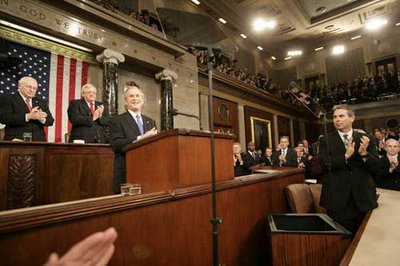
State of the Union 2006 (Photo: White House)
President Bush in Tuesday's State of the Union address:
Fellow citizens, we've been called to leadership in a period of consequence. We've entered a great ideological conflict we did nothing to invite. We see great changes in science and commerce that will influence all our lives. Sometimes it can seem that history is turning in a wide arc, toward an unknown shore. Yet the destination of history is determined by human action, and every great movement of history comes to a point of choosing.

Lincoln could have accepted peace at the cost of disunity and continued slavery. Martin Luther King could have stopped at Birmingham or at Selma, and achieved only half a victory over segregation. The United States could have accepted the permanent division of Europe, and been complicit in the oppression of others. Today, having come far in our own historical journey, we must decide: Will we turn back, or finish well?

Before history is written down in books, it is written in courage. Like Americans before us, we will show that courage and we will finish well. We will lead freedom's advance. We will compete and excel in the global economy. We will renew the defining moral commitments of this land. And so we move forward -- optimistic about our country, faithful to its cause, and confident of the victories to come.

Wednesday, February 01, 2006

Grassroots and the web

Minnesota Republicans are underutilizing the Internet. I'm not talking so much about the state party, but the party's BPOUs, the basic political operating units (local party groups organized in state Senate districts or counties).

There are only 29 BPOU web sites listed on the state GOP web site. Increasingly, people expect businesses and nonprofits to have a web site. Not having a web site in the 21st century is like having an unlisted telephone number in the 20th century.

BPOUs are the entry points for party activists. If the party wants to grow, it needs to provide an easy entry point for future delegates, election judges, volunteers, and candidates. Sure, you call the state party office at (651) 222-0022, but a web site can instantly provide a personalized, in-depth introduction to the local activist group.

A BPOU web site should:

  • Identify the area's elected officials

  • Identify the BPOU officers with contact information

  • Make it easy to make a contribution and obtain a Minnesota Political Contribution Refund (PCR)

  • Publicize BPOU events such as meetings, precinct caucuses, parades, conventions, and fundraisers

  • Invite and encourage participation

  • Articulate Republican values and platform points

  • Convey the image of an active, relevant, high-quality, and fun organization

Two of the best BPOU web sites according to these criteria are from Senate District 42 and Senate District 63.


The center column of the SD 42 home page has a news feed that is updated locally and continually, and includes links to news sources and sometimes even this blog. The site is packed with party and community event information, and includes a link for donations via PayPal. Somebody (or a group of somebodys) is working very hard on this site!


The SD 63 web site is another activist-centered web site with lots of great information. It includes a link to Jerry Plagge's SD63 blog.

Some BPOUs use web space and a format (template) provided by the state party. Other BPOUs roll their own, hosting their web site independently.

I am reminded of a vintage video with Ronald Reagan showing Republican voter ID and get-out-the-vote (GOTV) efforts using then state-of-the-art technologies: typewriters, ditto machines, maps, pushpins, and lots of volunteer power. BPOUs have a lot of unused potential power in Internet technologies such as web sites, e-mail, instant messaging, podcasting, RSS, and discussion groups. With each election cycle, these technologies will grow in importance in attracting the newer voters who are growing up with them. The state party should be aggressively enabling the BPOUs with these grassroots-reaching tools.

EPILOGUE: Just before I was going to publish this post, my point was disproven somewhat. I was invited to join the SD 43 Meetup Group, the 475th Republican Meetup Group on Meetup.com. This idea is a continuation of the successful national "Parties for the President" by the Bush Cheney '04 campaign. Check it out, this another way activists are using Internet technologies to find each other and make connections, which will be essential to winning elections in 2006. I'm glad to see that Republicans are "getting it."

Monday, January 30, 2006

The liberals hate it (the movie, that is)

James Franco in Annapolis

The movie Annapolis is getting panned by liberal film critics by linking it to George W. Bush (everything is political, don't you know):
"On the contrary, Annapolis, like most Disney-fied films with military or sport themes produced during the presidential reign of George II, is a celebration of conformity and the subjugation of individual will to the greater good." —Geoff Pevere, Toronto Star
(Hat tip to Hoorah the Blog.)

Hmmm, it's a feel-good cross between Rocky and An Officer and a Gentleman, highlighting one of the greatest service academies in the world and the values that make it and America great, in a time of war, and it has the liberal press suffocating in its own gag reflex. Sounds like a must-see to me!

Some mil-bloggers are nit-picking the film's inaccuracies, but hey, it's a movie, not a documentary. I'll post my review here. Feel free to leave your review in the comments.

Until then, Go Mids!

Friday, January 27, 2006

"Sending" our "kids" to war

On his afternoon radio show on 100.3 KTLK-FM with Sarah Janecek, Brian Lambert used a liberal rhetorical device against U.S. participation in the Global War on Terror. He wanted to know how many politicians who support the war are "sending their kids to war."

We may send our kids to school, send them to the grocery store, send them to fill up the gas tank in family car, but to say that we are "sending" our "kids" to war is a distortion of reality. Ours is an all-volunteer military, they are not "sent" by their parents or conscripted by their country. Its members are adults, not "kids," who enlist and re-enlist, not victims with no other options for career or higher education (another liberal myth that Lambert perpetuated on air). They are professionals who believe in our country and their mission, as epitomized in their enlistment oath:
I, _____, do solemnly swear (or affirm) that I will support and defend the Constitution of the United States against all enemies, foreign and domestic; that I will bear true faith and allegiance to the same; and that I will obey the orders of the President of the United States and the orders of the officers appointed over me, according to regulations and the Uniform Code of Military Justice. So help me God.

They all deserve our gratitude for their service preserving our liberty. Condescension and ignorance does these heroes a disservice.

Wednesday, January 25, 2006

Joel Stein: ignorant, but at least he's honest

Joel Stein's column in the Los Angeles Times caused quite a stir when he admitted, "I don't support the troops."
I've got no problem with other people — the ones who were for the Iraq war — supporting the troops...But I'm not for the war. And being against the war and saying you support the troops is one of the wussiest positions the pacifists have ever taken — and they're wussy by definition...The truth is that people who pull triggers are ultimately responsible, whether they're following orders or not.

Stein doesn't think much of you, either. He condescendingly explains those "Support Our Troops" car magnets like the one on your car: "...those little yellow ribbons aren't really for the troops...The real purpose of those ribbons is to ease some of the guilt we feel for voting to send them to war and then making absolutely no sacrifices other than enduring two Wolf Blitzer shows a day."

Stein admits, "I know this is all easy to say for a guy who grew up with money, did well in school and hasn't so much as served on jury duty for his country."

While I am disgusted by most of what Stein says in this column, I do give him credit for being the first liberal to join conservatives in exposing the contradiction between "supporting" the troops but not the mission they are fighting and dying for. His complete ignorance and lack of appreciation for the military is probably incurable without spending some time in the presence of one of our fine soldiers, sailors, airmen, or Marines returning from their recent deployment in The Global War on Terror, who might quote Col. Nathan Jessep, USMC:
Son, we live in a world that has walls, and those walls have to be guarded by men with guns...deep down, in places you don't talk about at cocktail parties, you want me on that wall. You need me on that wall. We use words like honor, code, loyalty. We use these words as the backbone to a life spent defending something. You use them as a punchline. I have neither the time nor the inclination to explain myself to a man who rises and sleeps under the blanket of the very freedom that I provide, and then questions the manner in which I provide it! I would rather you just said thank you and went on your way. Otherwise, I suggest you pick up a weapon and stand a post.

Hugh Hewitt had a riveting interview with Stein yesterday, and posted a follow-up on his blog. It was a tough, respectful, and revealing interview:
As I suspected, Mr. Stein really doesn't know anyone on active duty, hasn't been to any bases or any of the service academies, hasn't met with wounded or returning troops, and generally admits to being blissfully ignorant of the military. He could not recount a single book he has read about the military, and doesn't even know how big it is. He thinks the soldiers, sailors, airmen and Marines who have died in the GWOT have died in vain. He does not feel grateful for their service.

Tuesday, January 24, 2006

27 million Iraqis are free

Yesterday, President Bush gave a speech on the Global War on Terror at Kansas State University. During the question-and-answer session, an Iraqi American expressed her gratitude for the liberation of the Iraqi people:

Q: "Hello, Mr. President. I am an American Iraqi Kurd. I would like to salute you and salute all the troops are freeing 27 million people. They are free." (Applause.)

THE PRESIDENT: "Thank you."

Q: "Mr. President, I would like to share this thought with all our nation and everybody who is questioning what happened to the chemical weapons. Saddam burned 4,500 villagers. I lost more than 10 members of my family under the ground. We found their bones after, when we freed Iraq. Saddam, himself, and his people, his followers, they are chemical weapons. Please stop questioning the administration and their decision. It was the best decision anybody could take. Freeing 27 million people." (Applause.)

Friday, January 20, 2006

Conservatives just want to have fun (again)

The widely-reported Republican malaise is directly related to the party's drifting from its once-energetic conservative base. According to an Associated Press report by Ron Fournier:
Party leaders fear that while conservative voters may become disengaged, liberal voters will be galvanized by their opposition to the Iraq war and their frustration with minority-party status.

"I talk about an enthusiasm deficit, and I think we have a little bit of that," [Republican National Committee member from New Hampshire Tom] Rath said of Republican voters. "They say we need to get our act together. They still love this president. But they want to see movement on the things that brought us to power. We took the government over and promised to fix things."
In Minnesota, disgruntled conservatives may have a voice in the owner of everyone's favorite Stadium Village bar, Stub & Herb's. Sue Jeffers, outspoken opponent of smoking bans, recently announced her candidacy for governor. There is even speculation that she could challenge current governor Tim Pawlenty for the Republican endorsement.

To call Jeffers, who has never run for elected office, a longshot is an understatement, but for now, her nascent anti-smoking ban, pro-property owners platform and Minnesota populist, anti-establishment status has conservatives and libertarians buzzing with the possibilities.

Wednesday, January 11, 2006

Hollywood's "moderate Republicans"

In the midst of the Alito (or as Sen. Ted Kennedy says, "Alioto") confirmation hearings, I was coincidentally drawn to fix a snack and fire up the home theatre with... a movie about confirmation hearings!

The Contender (2004), directed by Rod Lurie, is the final September 10th-era political thriller, arguably the best since All The President's Men and before The Manchurian Candidate remake starring Denzel Washington. The performances are the film's greatest strength. Sen. Laine Hanson (Joan Allen) is picked by President Jack Evans (in a winning performance by Jeff Bridges) to replace his friend and Vice President, who dies in office. Republican Rep. Sheldon Runyon (Gary Oldman) chairs the House committee that will confirm the President's nominee. The main characters are joined by a well-cast roster of supporting players, including William Petersen (in his final pre-C.S.I role) as a rival Vice Presidential aspirant, Sam Elliot as President Evans's Chief of Staff Kermit Newman, and an intense yet understated cameo performance by Mariel Hemingway.

While the performances are first-rate, the political plot is incoherent. Its most politically authentic moment comes when the Evans administration is arguing with Hanson about how far to take the back-and-forth partisan dirty tricks:

Laine Hanson: If we do that, we'll be as bad as them.
Kermit Newman (furiously): We are as bad as them!

In The Contender, the Democrats are the good guys, while the Republicans are represented primarily by Rep. Runyon, power-drunk and graceless (in a fine, quirky caricature by Oldman). Runyon is determined to torpedo Sen. Hanson's nomination in favor of Petersen's Democrat governor character.

Politically, everyone in this movie is on the left — make that far left, even the Republicans:

  • One of Republican Rep. Shelly Runyon's proudest achievements was lobbying to make hate crimes a federal offense. In real life, Republicans would rather let hate crimes come under existing laws against harassment, murder, vandalism, etc.

  • Laine Hanson's father, a retired Republican governor, complains wearily that teachers are supposed to "teach, not preach" when Laine's toddler son says his public school teacher told him that Jesus made everything. (Not to worry, my son also believes in Santa Claus and the Easter Bunny, Laine tells her dad.) That's what you get in the public schools, Laine says. Huh? Are you kidding? Some public school teachers won't even say "under God" when reciting The Pledge of Allegiance, let alone give religious instruction in the classroom.

  • Democrat Rep. Reginald Webster secretly opposes his fellow Dem's nomination, telling Republican Rep. Runyon that her views are better suited to "the other side of the aisle." Sen. Hanson is portrayed as a Republican who switched parties, and therefore not "too liberal." Yet one has trouble imagining why any Democrat would think Hanson was too much like a Republican after hearing her closing statement in the movie's dramatic climax:

I stand for a woman's right to choose.

Nothing "too Republican" here...

I stand for the elimination of the death penalty.

...or here.

I stand for a strong and growing Armed Forces because we must stomp out genocide on this planet, and I believe that that is a cause worth dying for.

OK, Rep. Webster, she does sound almost like George W. Bush on this point.

I stand for seeing every gun taken out of every home -- period.

Yah, sure, a Republican who wants to repeal the Second Amendment.

I stand for making the selling of cigarettes to our youth a federal offense.

Forget the drug dealers, lets have our U.S. District Attorneys prosecute real the menace to society: convenience store clerks.

I stand for term limits and campaign reform.

And, Mr. Chairman, I stand for the separation of Church and State, and the reason that I stand for that is the same reason that I believe our forefathers did. It is not there to protect religion from the grasp of government but to protect our government from the grasp of religious fanaticism.

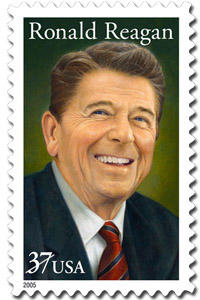
This one turns Ronald Reagan's 1982 quote inside-out and upside down: "The first amendment was not written to protect people and their laws from religious values; it was written to protect those values from government tyranny."

Now, I may be an atheist, but that does not mean I do not go to church. I do go to church. The church I go to is the one that emancipated the slaves and gave women the right to vote. It gave us every freedom that we hold dear. My church is this very Chapel of Democracy that we sit in together, and I do not need God to tell me what are my moral absolutes. I need my heart, my brain, and this church.

This one validates Dennis Prager, who says that people without religious faith think of government as their religion (as opposed to those evangelical fanatics without a heart or a brain).
Unfortunately, the unanimous leftward tilt to the politics of every character in the story make it difficult to believe that anyone involved would oppose Laine Hanson's nomination. This undermines the believability of the entire movie, but it's still a guilty pleasure for any political junkie. (On that note, 2004's The Manchurian Candidate re-does the policy discussion led by Joan Allen in this movie, with Meryl Streep playing the powerful Senator Eleanor Shaw. Allen was believable, but Streep nails this and other political scenes in the movie with a Hillary-like presence.)

Wednesday, January 04, 2006

Rebooting the RPM

Andy Aplikowski at Residual Forces is talking some tough love about the 2006 election cycle. Andy is the BPOU chair of the Senate District 51 Republicans, a fellow grassroots activist, a true believer and one of the rabble like me. He is alarmed at the performance of Republicans (candidates, leadership, activists, and voters) in recent special elections, notably the Ek Train Wreck in Saint Cloud, and I would add the disappointing voter turnout and outcome of the SD 43 special election.

Andy cites three main concerns:
  • Incumbent Republican legislators vacating their seats for other opportunities
  • Stronger ground game of the DFL (although I would call Andy's characterization of "well-oiled machine" debatable)
  • Lack of party unity under a strong leader

These legislators have stepped up to new opportunities in 2005: the former Sen. David Gaither (R-Plymouth) is now Governor Pawlenty's chief of staff; former Sen. Dave Kleis (R-St. Cloud) is now the mayor of Saint Cloud; and former Sen. Mark Ourada (R-Buffalo) is now vice president for external relations for the Center for Energy and Economic Development. Rep. Jeff Johnson (R-Plymouth) is running for Minnesota Attorney General this year.

Today, Gaither's and Kleis's seats have moved to the DFL side of the aisle, while Senator elect Amy Koch keeps Ourada's seat on the R side. "Triple A" says that the party needs to stop the "bleeding" of legislative resignations:
First off, we cannot have our sitting office holders quit, retire, or move on to other/higher offices. We cannot afford to lose one more seat. IÂ’m betting that in the 6th CD one of the 3 candidates who currently hold a spot in the State Legislature will get the nod, and likely be the next Congressperson. That will be another seat lost. Jeff Johnson is running for AG, he could be another lost seat. There are other Republicans thinking of or committed to retiring. We are in serious trouble folks.

The fact is, the strongest in any field will move up and out — and we need them to. Would we be better off as Republicans had Tim Pawlenty stayed a legislator rather than run for Governor? Or Norm Coleman not run for U.S. Senate? Of course this puts pressure on the BPOUs to pull someone off the bench to defend an open seat, and sometimes the seat is lost. I admit to feeling a combination of pride and terror when I first heard about David Gaither's resignation. But a ban on legislative resignations would never work. Instead, the party needs to develop the mythical "deep bench" of candidates who can step forward when a vacancy arises.

Improving the ground game at the BPOU level is something over which we have a little more control. Hopefully, BPOU executive committees are meeting now to assess past performance and gear up for a year of growing the party, planning strategy, and executing on the fundamentals of voter ID and 72-hour (election day) operations.

Regarding leadership, it's a safe bet that The Governor will soon be in full campaign mode for his own re-election. Whether he can find the right balance of rallying his conservative base and appealing to Minnesota's populist instincts ("We need a governor who goes to Sam's Club, not just the country club") remains to be seen.